What Is Self-Adhesive Vinyl and What Is It Used For?
If you have ever peeled a sticker off its backing paper, you already understand the basic principle of self-adhesive vinyl. The material is more sophisticated than a sticker — the substrates are better, the adhesives are more controlled, and the applications are significantly more varied — but the fundamental idea is the same. It sticks to things.
What makes self-adhesive vinyl interesting is not any single property but the combination of them. It is printable, flexible, removable or permanent depending on the grade, available in dozens of surface finishes, and applicable to almost any flat or mildly curved surface. That combination of characteristics is why you encounter it constantly without necessarily recognizing what you are looking at.
What It Actually Is
Self-adhesive vinyl is a thin, flexible film made from polyvinyl chloride — PVC — with a pressure-sensitive adhesive applied to one side and a release liner protecting the adhesive until the material is ready to use. The release liner is the backing paper you peel away before applying the vinyl to a surface.
The vinyl film itself can be manufactured in different thicknesses, surface textures, and opacity levels. The adhesive layer determines how aggressively the vinyl bonds to surfaces, how cleanly it removes, and how long it maintains its bond over time. The release liner is simply there to protect the adhesive during storage and handling — it goes in the bin once the vinyl is applied.
Different grades of self-adhesive vinyl exist for different purposes. The grade determines the outdoor durability, the print receptiveness, the surface texture, and whether the vinyl is designed to be permanent or removable. Choosing the right grade for the application matters more than most first-time buyers realise — a vinyl specified for short-term indoor use will fail prematurely outdoors, and a permanent-adhesive grade will damage surfaces when removed if a removable grade was what the application actually needed.
The Surface Finishes — What the Options Actually Mean
Walk into any display or signage supplier and you will be asked to choose a surface finish before anything else. The main options are:
Gloss is the most common surface finish for printed self-adhesive vinyl. It produces vivid, saturated colours and a reflective surface sheen. Gloss vinyl makes colours pop — particularly reds and yellows — which is why it dominates the promotional and retail display market. The downside is that gloss surfaces show fingerprints easily and can create unwanted reflections under certain lighting conditions.
Matte produces a flat, non-reflective surface that reads as more sophisticated and subdued than gloss. Matte vinyl is widely used in office environments, premium retail, and any application where a gloss sheen would feel out of place. Colours appear slightly less vivid on matte surfaces than on gloss — but the overall effect is cleaner and more controlled under mixed lighting.
Satin sits between gloss and matte — a soft sheen that is partially reflective but not mirror-bright. Satin is often the default choice for environments where neither full gloss nor full matte is quite right.
Frosted and transparent finishes are used for window applications specifically — frosted vinyl mimics the appearance of sandblasted glass and is used for privacy screening and decorative window graphics, while transparent vinyl allows the substrate surface to show through the applied film.
Where Do You Actually Find It?
Self-adhesive vinyl is everywhere once you start looking for it.
The lettering on a shop window is almost certainly cut vinyl — the individual letters are cut from a roll of self-adhesive vinyl and applied directly to the glass. The vehicle livery on a delivery van is printed self-adhesive vinyl, typically with a specialised automotive-grade adhesive designed to bond to vehicle paint without damaging it on removal. The floor graphics at a shopping centre activation are a heavy-duty self-adhesive vinyl with a textured anti-slip laminate over the print. The frosted panels in an office meeting room are self-adhesive frosted vinyl applied to standard glass.
In the display and signage industry, self-adhesive vinyl is one of the most fundamental materials in production — used for everything from window graphics and wall decals to vehicle wraps and floor markings.
At home, self-adhesive vinyl shows up as furniture wrapping film — used to resurface cabinet doors and drawer fronts without replacement — and as the material behind most decorative wall stickers. Custom wallpaper murals in retail and hospitality environments are almost always self-adhesive vinyl printed to order rather than traditional wallpaper paste-and-hang products.
Removable vs Permanent — Why This Matters
The adhesive grade is the specification decision that causes the most problems when it gets wrong.
Permanent-adhesive vinyl is formulated to create a long-term bond with the substrate surface. It is designed for applications where the vinyl will not need to be removed — external building signage, vehicle livery that will stay on for years, floor graphics in permanent retail environments. Permanent adhesive creates a stronger bond over time and is more resistant to edge lifting in outdoor conditions. The trade-off is that removal typically leaves adhesive residue and can damage painted or delicate surfaces.
Removable-adhesive vinyl uses a lower-tack adhesive formulation designed to release cleanly from most surfaces without leaving residue. It is used for temporary promotional graphics, seasonal window displays, event floor graphics, and any application where the vinyl needs to come off without damaging the surface underneath. The trade-off is that removable adhesive bonds less aggressively — it is more prone to edge lifting in outdoor conditions and has a shorter reliable service life.
The mistake most people make is assuming that permanent means better. For temporary applications, permanent adhesive creates a worse outcome — a vinyl that is harder to remove than necessary and more likely to damage the surface beneath it. Specifying the right adhesive grade for the actual application is more important than defaulting to whichever grade the supplier has in stock.
How Long Does It Last?
Service life varies considerably depending on the grade, the application environment, and the surface it is applied to.
Indoor self-adhesive vinyl in a controlled environment — an office, a retail interior, a dry storage area — will typically maintain its appearance and adhesion for 3 to 7 years. The limiting factor is usually UV exposure from windows and artificial lighting rather than the adhesive failing.
Outdoor self-adhesive vinyl needs UV stabilisation to resist the sun degrading the PVC film and fading the print. Standard outdoor vinyl without UV treatment will show visible colour fading within 6 to 12 months of outdoor exposure. UV-stabilised outdoor grades extend this to 3 to 5 years in most climates — longer in cooler, less sunny environments, shorter in very high UV regions where the degradation rate is significantly accelerated.
Cast vinyl — a premium grade produced through a different manufacturing process than the standard calendered vinyl — offers the longest outdoor service life of any self-adhesive vinyl product, typically 7 to 10 years, and is the standard specification for long-term vehicle livery and external building graphics.
Applying It — The Bit That Goes Wrong
The material itself is straightforward. The application is where most problems occur.
Surface preparation is the step most people skip. Self-adhesive vinyl bonds to clean, dry, grease-free surfaces. Applying vinyl to a surface that has not been cleaned removes a significant portion of the adhesive’s effectiveness immediately — the bond forms partly with the contamination layer rather than the surface itself, and the vinyl begins lifting at the edges far sooner than it should.
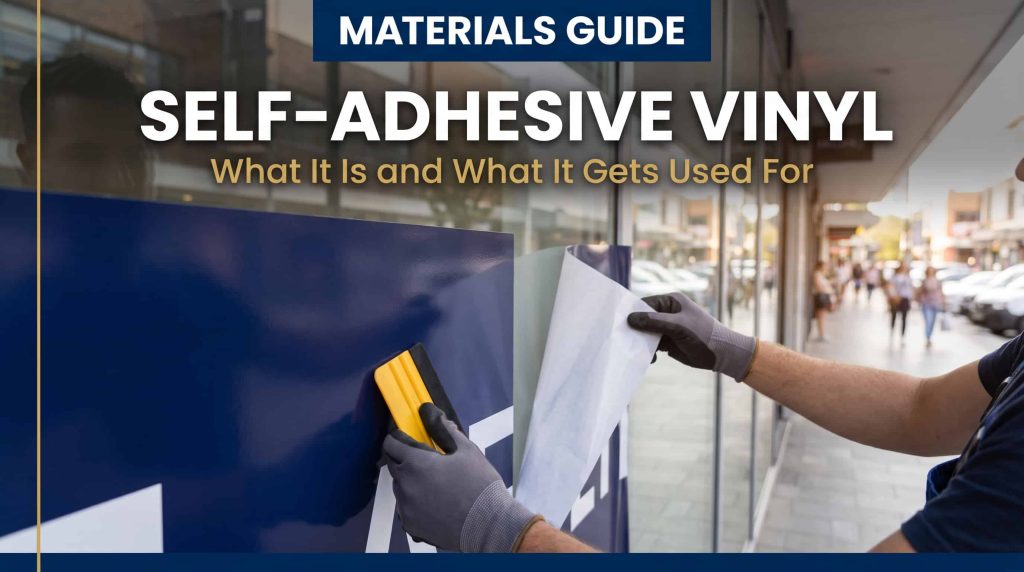
Air bubbles are the most visible application problem. They occur when the vinyl is laid down flat rather than applied progressively from one edge using a squeegee. A squeegee or application tool forces air out ahead of the advancing vinyl and produces a bubble-free finish. Trying to remove bubbles after the fact by puncturing them is a workaround — the puncture mark remains visible in most surface finishes.
On complex curved surfaces — vehicle body panels, curved signage — using heat during application softens the vinyl and allows it to conform to the curve without distorting or lifting at the edges. Cold vinyl applied to a tight curve will contract slightly as the temperature drops and begin lifting within days.
The Short Version
Self-adhesive vinyl is a pressure-sensitive PVC film that sticks to flat and mildly curved surfaces, accepts print, comes in multiple surface finishes and adhesive grades, and is used across signage, display, automotive, retail, interior design, and promotional applications. It is the material behind most of the flat graphics you encounter in commercial environments without thinking about what they are made from.
The choices that matter when buying it are the grade (indoor vs outdoor vs cast), the adhesive type (removable vs permanent), and the surface finish (gloss, matte, satin, frosted). Get those three right for the application and the rest of the job is straightforward.