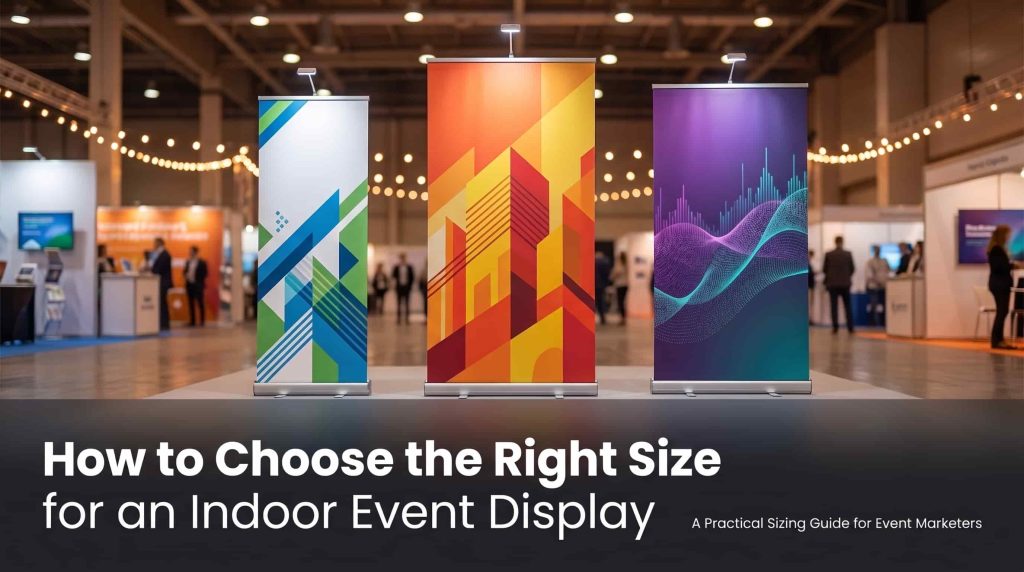

Walk into any trade show, corporate event, or retail activation and you will see rollup banners everywhere. Some command attention. Others disappear into the background. The difference is rarely the quality of the design — it is the size.
Choosing the wrong rollup banner size for an indoor event display is one of the most common and most avoidable mistakes event marketers make. Too small and the display gets lost in the environment. Too large and it overwhelms the space, creating a cluttered rather than professional impression.
This guide covers everything you need to know to choose the right rollup banner size for any indoor event display — regardless of venue, stand size, or budget.
Why Size Matters More Than You Think
Most people approach rollup banner sizing as a practical question — what fits in the space? But size affects far more than just fit. It affects:
Visibility from a distance. A banner that is too narrow for the space it is placed in becomes invisible to visitors approaching from more than 3 metres away. The message simply does not have enough visual mass to register.
Proportionality. A single narrow banner on a wide exhibition stand looks like an afterthought. Multiple banners that are too wide for a compact space look cramped and disorganized. Getting the proportions right is what makes a display look considered and professional.
Readability. The width of a rollup banner determines how much design space is available for text and graphics. A wider banner gives designers more room to scale up headlines, increase image size, and create breathing space around content — all of which improve readability at distance.
Perceived brand quality. An undersized display in a large space signals to visitors that the exhibitor has not invested seriously in their event presence. A correctly proportioned display signals professionalism and preparation — before a visitor has read a single word.
Standard Rollup Banner Sizes Explained
Rollup banners come in a small number of standard widths. Understanding what each width is designed for makes the selection process much simpler.
800mm Wide
The 800mm rollup banner is the smallest standard format. It is designed for tight spaces — compact retail environments, small reception areas, narrow corridors, and any location where a standard-width banner would be too dominant.
At 800mm wide, the design space is limited. Headlines need to be short and graphic elements need to be simple. This format works well when multiple banners are used in sequence — creating a combined display effect without any individual panel being too wide for the environment.
Best for: Retail counters, small reception areas, tight venue spaces, multi-banner corridor displays.
850mm Wide
The 850mm rollup banner is the most widely used standard format globally. It is the default specification for most trade shows, corporate events, and retail activations — and for good reason. At 850mm wide, there is enough design space to accommodate a strong headline, a supporting visual, and a call to action without the panel feeling crowded.
The 850mm format is versatile enough to work as a standalone display in a compact space and as part of a multi-banner configuration in a larger environment.
Best for: Standard exhibition stands, corporate event displays, retail environments, conference and seminar spaces, most general indoor event applications.
1000mm Wide
The 1000mm rollup banner is a wide format — 15% wider than the standard 850mm. The additional width creates noticeably more visual presence and allows designers to work with larger type, bigger images, and more generous spacing.
At events where visual competition is high — large trade shows with dozens of exhibitors in close proximity — the 1000mm format helps a display stand out from the sea of standard-width banners surrounding it.
The 1000mm format is heavier and slightly less portable than the 850mm — a consideration for exhibitors who travel frequently between events.
Best for: Larger exhibition stands, high-competition trade show environments, single-banner displays where one panel needs to carry the full visual weight of the display.
1200mm Wide
The 1200mm rollup banner is the widest standard format. It creates maximum visual presence and is typically used for large-scale display configurations, outdoor activations, or premium brand environments where visual impact takes priority over portability and cost.
At 1200mm wide, a single banner creates a substantial display presence. Two 1200mm banners side by side create a near-seamless backdrop effect for large stand configurations.
Best for: Large exhibition stands, premium brand activations, outdoor and semi-outdoor event displays, high-impact standalone displays.
The Three Questions That Determine the Right Size
Rather than guessing, ask these three questions before specifying any indoor event rollup banner.
Question 1 — What is the width of the space?
The total width of the display space determines the maximum and minimum banner width. A useful rule of thumb is that the combined width of all banners in a display should fill 60% to 80% of the available space. Less than 60% and the display looks undersized. More than 80% and it starts to feel cramped.
For a 3 metre wide exhibition stand:
- A single 850mm banner fills 28% of the space — too little visual presence as a standalone
- Two 850mm banners fill 57% of the space — at the lower edge of the recommended range
- Three 850mm banners fill 85% of the space — strong combined display with appropriate presence
Question 2 — What is the expected viewing distance?
Viewing distance is the factor most people ignore — and it has a significant impact on which size is correct.
At short viewing distances — under 2 metres — an 800mm or 850mm banner is perfectly adequate. The viewer is close enough for text and graphics to register clearly at standard size.
At medium viewing distances — 2 to 5 metres — an 850mm to 1000mm banner is more appropriate. The additional width gives designers more room to scale up text and visuals to the size needed for comfortable reading at distance.
At long viewing distances — beyond 5 metres — a 1000mm to 1200mm banner, or multiple standard banners used together, is needed to create a display that registers clearly from across a large hall or open space.
Question 3 — How many banners are you using?
The number of banners in the display changes the sizing calculation significantly. Two standard 850mm banners used side by side create 1700mm of total display width — more than a single 1200mm banner — at a lower combined cost and with better portability.
Multiple banners also create flexibility. A two-banner configuration at one event can become a three-banner configuration at a larger venue — with no new fabrication cost.
As a general principle, multiple standard-width banners will outperform a single wide-format banner in most indoor event contexts, for both cost-effectiveness and display flexibility.
Height — The Forgotten Dimension
Most guidance on rollup banner sizing focuses on width — but height is equally important.
Standard rollup banner height is 2000mm — 2 metres. This is a near-universal standard across all major manufacturers and suits the vast majority of indoor event venues. It positions the top of the banner well above head height, ensuring the headline and logo are visible over crowds.
Some premium rollup banner systems extend to 2100mm or 2200mm — slightly increasing headline visibility in large venues with high ceilings.
Before specifying any height above the standard 2000mm, confirm ceiling clearance at the venue. Low-ceiling venues — hotel meeting rooms, some conference centres — may not accommodate extended-height banners. A banner that cannot fully extend is a wasted investment.
Single Banner vs Multiple Banners
One of the most important sizing decisions for indoor event displays is whether to use a single large banner or multiple standard banners.
Single large banner advantages:
- Fewer pieces to transport and set up
- Seamless single-panel visual impact
- Better suited to venues with very limited space
Multiple standard banner advantages:
- More total display width at lower combined cost
- Better portability between events
- More flexibility to adapt the configuration to different venue sizes
- If one banner is damaged, the rest of the display still functions
For most indoor event applications, multiple 850mm banners outperform a single large-format banner on cost, flexibility, and practicality. The exception is a premium brand environment where the seamless single-panel aesthetic is part of the brand presentation.
Size Selection by Event Type
Different indoor event types have different display requirements. Here is a quick reference by event type:
Trade shows and exhibitions (large venues): 850mm to 1000mm individual banners, typically two to three in combination. Large stands with significant floor space may suit 1000mm to 1200mm formats or multiple 850mm banners creating a backdrop effect.
Corporate conferences and seminars: 850mm standard format suits most conference and seminar environments. The controlled, professional setting of a conference does not require the visual aggression of wider formats.
Retail activations and in-store displays: 800mm to 850mm — retail environments typically have tighter dimensions than exhibition halls and shorter viewing distances. Compact formats work better and transport more easily between locations.
Hotel and hospitality events: 850mm standard format for most hotel meeting room and ballroom environments. Confirm ceiling height before specifying anything above standard 2000mm height.
Outdoor and semi-outdoor activations: 1000mm to 1200mm — outdoor environments have no walls to frame the display. Wider formats create more visual presence in open-air settings. Always confirm whether the venue and banner system are rated for outdoor use before deploying rollup banners in semi-outdoor conditions.
The Pre-Order Checklist
Before placing any rollup banner order for an indoor event display, confirm:
- Total available display width at the venue
- Expected viewing distance from approaching visitors
- Number of banners in the planned configuration
- Ceiling height at the venue (for anything above 2000mm)
- Whether the display will be moved between multiple events (portability requirements)
- Whether the same configuration will be used in multiple venue types (flexibility requirements)
Answering these questions before ordering eliminates the most common sizing mistakes and ensures the display delivers the visual impact the investment deserves.
Size Is a Strategic Decision
Choosing the right rollup banner size for an indoor event display is not a minor logistical detail. It is a strategic decision that affects visibility, brand perception, readability, and value for money across every event the display attends.
The right size is not the cheapest option that fits in the space. It is the size that creates the right visual presence for the specific venue, audience, and event context — and that serves the display well across the full range of indoor event environments where it will be used.
Get the size right from the start and a rollup banner becomes one of the most versatile, cost-effective, and high-impact display tools available for indoor events of any scale.