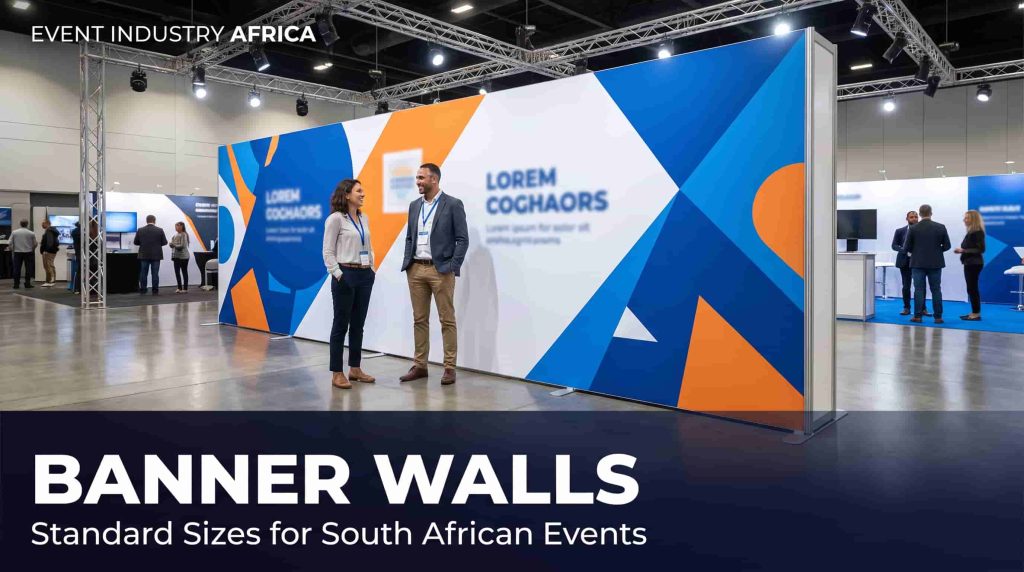

There is no single universal bannerwall size. The correct dimensions depend on the system type, event space, and viewing distance. The intended use — backdrop, booth wall, or media wall — determines the format.
Furthermore, understanding the standard size options available in South Africa’s display market helps businesses order correctly the first time — and avoid ordering a wall that does not fit the allocated event position.
What Are the Standard Bannerwall Sizes in South Africa?
Straight Fabric Banner Walls
Straight fabric banner walls are the most widely used format across South African corporate events, trade shows, and product launches. They use a tensioned fabric graphic stretched across an aluminium frame — creating a seamless, flat display surface without visible joins in the graphic.
Specifically, standard straight bannerwall widths available in South Africa include:
2 metres wide x 2.3 metres high — the entry-level size for small event spaces, conference backdrops, and corporate interview or photography positions. Suitable for a single person standing in front of the display or a small group of two to three people.
3 metres wide x 2.3 metres high — the most common corporate event and trade show backdrop size in South Africa. Suitable for a group of three to five people and fits within most standard shell scheme booth depths.
4 metres wide x 2.3 metres high — suitable for larger trade show positions, product launch backdrops, and media wall applications where a wider coverage area is required. Furthermore, this size suits brand activations where multiple simultaneous interactions at the display are expected.
5 metres wide x 2.3 metres high — large event backdrop format for major trade shows, conference main stages, and exhibition environments where the x banner anchors the entire brand space.
6 metres and above — modular configurations combining multiple frame sections. Consequently, most straight bannerwall systems in South Africa support extension modules — additional 1-metre or 2-metre frame sections that extend the display to any required width. Consequently, there is no practical upper width limit for straight bannerwall systems using modular framing.
Moreover, height is typically fixed at 2.3 metres for standard systems — matching standard ceiling heights and event access constraints. However, some suppliers in South Africa offer 2.5 metre and 3 metre height options for specific applications.
Curved Fabric Banner Walls
However, curved bannerwall systems use an arched aluminium frame that creates a concave or convex curved display — adding dimension and visual interest that straight wall systems cannot achieve.
Standard curved bannerwall configurations:
Half curve — a shallow curved section typically 2 metres to 3 metres across. Frequently used as corner display elements or standalone brand presence displays at smaller events.
Full curve — a deeper curved arc typically 3 metres to 5 metres across. Creates a more immersive brand environment — visitors approaching from the front see the display wrapping around them slightly. Moreover, the curved format reads differently from straight walls across a crowded trade show floor — catching the eye from angles that flat displays do not.
S-curve — a combined concave-convex curve that creates a wave profile across the display. Less common but used for high-impact premium brand environments where the visual distinctiveness of the installation is part of the brief.
Pop-Up Banner Wall Systems
Additionally, pop-up banner wall systems use a spring-loaded grid frame that unfolds and locks into position without tools. The graphic panels — typically magnetic-backed rigid panels or tension fabric — attach to the frame.
Standard pop-up bannerwall sizes in South Africa:
3×3 grid — approximately 2.2 metres wide x 2.2 metres high. The standard entry-level pop-up system for small to medium events.
5×3 grid — approximately 3.6 metres wide x 2.2 metres high. The most widely used pop-up size in South Africa’s trade show market. Fits within most standard 3-metre shell scheme booth widths.
7×3 grid — approximately 5 metres wide x 2.2 metres high. Larger corporate event format for wider stand positions.
Additionally, pop-up systems are the most portable bannerwall format — the frame folds into a wheeled carry case that transports easily. Therefore, this makes them the practical choice for businesses that travel frequently with display materials.
Step and Repeat Banner Walls
Step and repeat banner walls display a repeating pattern of logos — used at media events, award ceremonies, product launches, and brand activations where photography is part of the event programme.
Standard step-and-repeat sizes in South Africa:
2.4 metres wide x 2.4 metres high — standard media wall size for corporate events and product launches. Fits two to four people comfortably in frame.
3 metres wide x 2.4 metres high — larger media wall for events with multiple simultaneous photography positions.
6 metres wide x 2.4 metres high — major event format for brand activations, premiere events, and large-scale media wall applications.
The logo repeat spacing on a step-and-repeat wall depends on the logo size and the typical photography crop. Specifically, size each logo repeat so that two to three complete instances appear in a standard portrait photograph — regardless of where the subject stands.
How to Choose the Right Bannerwall Size for Your Event
Match the size to the viewing distance — a banner wall seen from 2 metres away needs different sizing logic from one seen from 10 metres across a trade show floor. Larger text and logo elements at wider formats. Finer detail works at closer viewing distances.
Match the width to the available space — a 5-metre banner wall in a 3-metre shell scheme position does not fit. Measure the available wall or back-of-stand space before confirming any order.
Consider the photography use case — if the bannerwall will be used as a photography backdrop, the width needs to accommodate the expected group size plus adequate bleed on either side. A two-person photograph in front of a 2-metre wall looks tight. A 3-metre wall gives comfortable framing.
Factor in transport and storage — larger modular straight walls and curved systems break down into more components and require more transport space. Consequently, businesses that travel frequently with their display materials should factor in the carry case dimensions and weight before ordering.