
What Is Large Format Printing and What Is It Used For?
Most people have seen large format printing without knowing what it is called. That banner stretched across the back wall of an exhibition stand. The vinyl graphic covering an entire shop window. The building wrap that turns a construction hoarding into a 10-metre advertisement. The vehicle graphic that makes a plain white van look like a moving billboard.
All of these are large format printing. The term simply means printing at sizes that standard desktop or office printers cannot produce — and the applications range from small A1 event posters right through to graphics that cover entire building facades.
Here is what large format printing actually means, how it works, and where it gets used.
The Definition — What Makes Something “Large Format”
There is no single universally agreed width where printing becomes “large format.” In practice, the industry uses 600mm as the general threshold. Anything wider than 600mm that requires specialist wide-format printing equipment falls into the large format category.
Standard office and commercial printers max out at around A3 — 297mm x 420mm. Some specialist small format printers reach 330mm or 500mm wide. Above that, you need wide-format inkjet printing equipment — machines specifically designed to print on media up to 5 metres wide and at any length the roll of material allows.
The size range within large format printing is enormous. An A1 exhibition poster is technically large format. So is a building wrap that covers 600 square metres of glass and steel. The equipment, materials, and processes involved are completely different at those two ends of the scale — but both fall under the same broad category.
How Large Format Printing Works
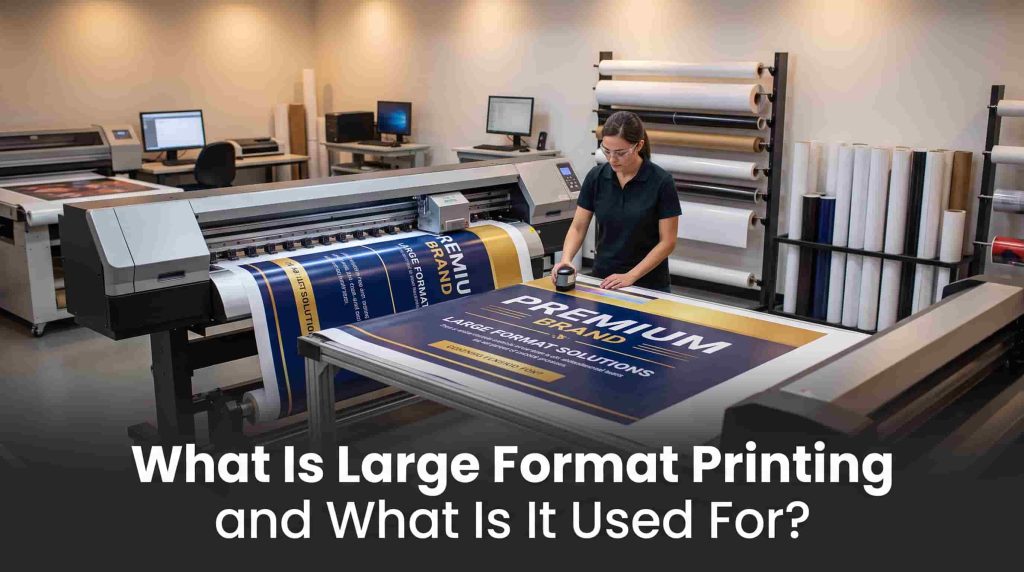
Wide-format inkjet printers work on the same basic principle as a desktop inkjet printer — microscopic droplets of ink are sprayed onto a surface through tiny nozzles as the print head moves across the media. The difference is scale and precision.
Wide-format inkjet printers used for large format printing are purpose-built machines. The print head travels across media that can be 5 metres wide or more. The ink systems are designed for the specific demands of large format output — UV-resistant formulations for outdoor applications, dye-sublimation systems for fabric printing, and UV-curable inks that bond directly to rigid substrates without the need for separate lamination in some applications.
Large format printing also uses UV flatbed printers — machines that print directly onto rigid substrates like aluminium composite panels, acrylic sheets, and foam board. Unlike roll-fed wide-format printers, flatbed printers hold the substrate flat on a bed and move the print head above it. This allows direct printing onto materials that cannot be fed through a roll-fed machine.
What Materials Can Large Format Printing Use?
One of the most significant differences between large format printing and standard printing is the range of materials it can print on. Standard printing is essentially limited to paper and card. Large format printing opens up a completely different range of substrates.
Vinyl is the most widely used large format printing material. Available in self-adhesive, non-adhesive, perforated, and mesh varieties — vinyl covers the majority of outdoor advertising, vehicle graphics, window graphics, and retail display applications.
Fabric is used for exhibition displays, flags, tension fabric structures, and soft signage. Dye-sublimation printing onto polyester fabric produces vivid colours with a premium finish and no glare — making fabric the preferred material for high-end exhibition backdrops and event displays.
Rigid boards — aluminium composite panels, foam board, PVC foam, and acrylic — are printed directly using UV flatbed printers. These are used for permanent signage, retail displays, and architectural graphics applications.
Canvas is used for photographic reproduction and fine art printing at large format sizes.
Backlit film is designed for illuminated applications — lightboxes, illuminated signage faces, and backlit display panels.
Mesh vinyl is perforated to allow wind to pass through — used for large outdoor banners on building scaffolding, fences, and exposed locations where solid vinyl would create unsafe wind loading.
What Is Large Format Printing Used For?
The applications for large format printing span almost every industry and environment. These are the most common uses.
Exhibition and Event Displays
Exhibition stands, trade show backdrops, event banners, and pop-up displays are among the most common large format printing applications globally. The ability to produce large, high-impact branded graphics quickly and cost-effectively makes large format printing the standard production method for event display materials.
Tension fabric systems — fabric graphics stretched over aluminium frame structures — dominate the premium end of the exhibition display market. Vinyl banner systems cover the more accessible end. Both rely on large format printing for the graphic production.
Outdoor Advertising
Building wraps, billboard graphics, hoarding panels, banner displays, and outdoor poster sites all use large format printing. Outdoor large format printing uses UV-resistant inks and weather-rated substrates to produce graphics that withstand UV radiation, temperature variation, moisture, and physical handling in outdoor environments.
Retail and Point-of-Sale Displays
Retail environments use large format printing extensively — window graphics, floor graphics, hanging banners, in-store promotional displays, and wall graphics are all produced using large format printing. The ability to produce large, visually striking graphics at competitive cost makes large format printing the production method of choice for retail visual merchandising.
Vehicle Graphics
Vehicle wraps and fleet graphics are a large format printing application that has grown significantly. Self-adhesive vinyl graphics — either partial decals or full vehicle wraps covering the entire vehicle surface — transform standard commercial vehicles into moving advertising. Cast vinyl formulations designed for vehicle curves and high-temperature outdoor exposure are used for quality vehicle graphic applications.
Architectural and Environmental Graphics
Wall murals, environmental graphics, wayfinding signage, and architectural branding installations all use large format printing. Office environments, hospitality venues, healthcare facilities, and retail spaces use large format printing to create branded environments — covering walls, floors, ceilings, and architectural elements with graphic content.
Signage
Exterior and interior signage production uses large format printing extensively. Building fascia graphics, directional signage panels, safety signage, and informational displays are all produced using large format printing on appropriate substrates.
Large Format Printing vs Standard Printing — The Key Differences
The distinction between large format and standard printing goes beyond just size. The equipment, materials, resolution specifications, finishing processes, and cost structures are all fundamentally different.
Standard printing produces at 300 DPI or above — correct for output viewed at close range, typically 30 to 50 centimetres. Large format printing produces at 72 to 150 DPI at final print size — correct for output viewed from 1 to 10 metres or more. The lower resolution is not a quality compromise — it is the appropriate specification for the viewing distances at which large format output is actually seen.
Standard printing costs decrease significantly with volume — printing 1,000 business cards costs significantly less per unit than printing 10. Large format printing costs on a per-square-metre basis — a single large format print is economically practical because there is no minimum volume requirement and no significant set-up cost per unit.
Standard printing finishing includes cutting, folding, binding, and laminating. Large format printing finishing includes hemming and eyelets for fabric banners, contour cutting for shaped vinyl graphics, mounting onto rigid substrates, and professional installation for wall wraps, vehicle graphics, and building signage.
Frequently Asked Questions
What counts as large format printing?
Any printing wider than approximately 600mm that requires specialist wide-format printing equipment is considered large format printing. This includes everything from A1 posters and exhibition banners through to vehicle wraps and building wraps covering hundreds of square metres.
What equipment is used for large format printing?
Large format printing uses wide-format inkjet printers — machines that print on media up to 5 metres wide — and UV flatbed printers that print directly onto rigid substrates. The specific equipment depends on the substrate, the ink type required, and the application.
What resolution does large format printing use?
Large format printing typically uses 72 to 150 DPI at final print size, depending on the viewing distance. Output viewed from 1 to 3 metres uses 150 DPI. Output viewed from more than 5 metres uses 72 DPI. These resolutions produce output that is indistinguishable from higher resolutions at typical large format viewing distances.
What materials can large format printing produce onto?
Large format printing produces onto vinyl, fabric, aluminium composite panels, foam board, PVC foam, acrylic, canvas, backlit film, and mesh vinyl. This substrate range is significantly wider than standard printing, which is essentially limited to paper and card.
How is large format printing different from standard printing?
Large format printing uses specialist wide-format equipment, prints at lower DPI suited to distance viewing, produces onto a wide range of substrates beyond paper and card, costs on a per-square-metre basis rather than per-unit volume, and uses specialist finishing processes including installation. Standard printing is suited to close-range reading on paper and card at high volume.