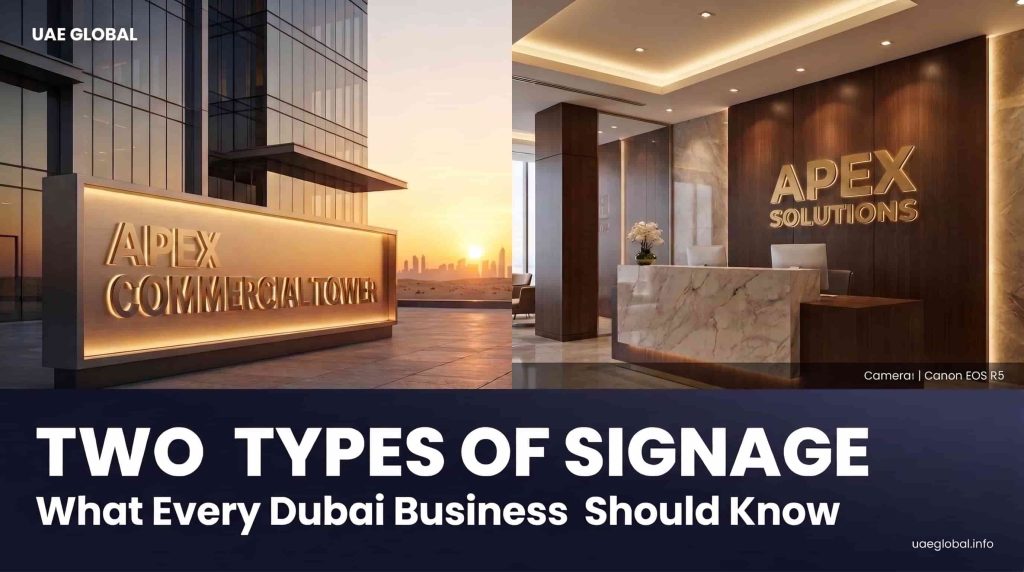

Signage is everywhere in Dubai — on building facades, inside shopping centres, at the entrance of corporate offices, on vehicles, in hotel lobbies, and across the city’s retail streets. Most people interact with signs dozens of times a day without categorising them. But from a business perspective, understanding the two main types of signage matters — because each one serves a different purpose, uses different materials, and requires different decisions to get right.
The two main types of signage are outdoor signage and indoor signage. The distinction sounds simple. The implications for how each type is specified, fabricated, and used in Dubai’s commercial environment are significant.
Type 1 — Outdoor Signage
Outdoor signage covers everything installed on building exteriors, in public spaces, on vehicles, and in any environment exposed to Dubai’s outdoor conditions. It is the most visible category of signage in the city — and the one that faces the most demanding environmental requirements.
What Outdoor Signage Does
The primary job of outdoor signage in Dubai is identification and attraction. A building fascia sign tells a person approaching from the street or the car park what business is inside. A pylon sign at a road entrance makes a business visible to drivers who would otherwise miss it. A vehicle wrap turns a commercial vehicle into a moving advertisement. An outdoor banner at an event entrance directs foot traffic and establishes the brand presence for the occasion.
In Dubai’s commercial environment — where multiple businesses often occupy the same building, where street-level retail competes for attention from pedestrians and drivers simultaneously, and where the city’s architectural scale means signs need to be legible from significant distances — outdoor signage is frequently the first and only impression a business makes on a potential customer before they make the decision to enter.
What Makes Outdoor Signage Different
Dubai’s outdoor environment is genuinely demanding. The UV index regularly hits extreme levels. Summer surface temperatures on metal and glass regularly exceed 70°C. Salt air from the coast affects materials in areas like Dubai Marina, JBR, and the Palm. Sandstorms create abrasive conditions that degrade surface finishes.
Outdoor signage in Dubai must be specified for all of these conditions simultaneously — not just for how it looks in a design presentation. Materials that work perfectly indoors or in milder climates degrade rapidly in Dubai’s outdoor environment. Inks that hold their colour on a monitor fade visibly within weeks on an outdoor sign if they are not UV-rated. Adhesives that hold vinyl graphics securely in a controlled environment fail in the thermal cycling that Dubai’s outdoor surfaces create.
Common Outdoor Signage Types in Dubai
Building fascia signs — flat panel signs, 3D letter signs, and illuminated channel letter signs mounted on building exteriors. The most common outdoor signage type for retail, hospitality, and corporate businesses across Dubai.
Pylon and totem signs — freestanding illuminated signs at building entrances and roadside locations. Used by businesses that are set back from the road and need to attract attention from moving traffic.
Outdoor banners and hoardings — large format vinyl graphics on temporary or semi-permanent structures. Widely used for construction site hoardings, event advertising, and promotional campaigns.
Vehicle wraps and fleet graphics — adhesive vinyl graphics on commercial vehicles. One of the most cost-effective outdoor advertising formats available in Dubai, turning vehicles into moving billboards that reach audiences across the city.
Wayfinding signage — directional signs guiding people through car parks, campuses, mixed-use developments, and public spaces. Often overlooked in terms of brand investment, but critically important for the user experience of large commercial developments.
Type 2 — Indoor Signage
Indoor signage board covers everything installed inside a building — in retail environments, corporate offices, hotels, hospitals, airports, shopping centres, and any internal commercial space. It operates in controlled conditions — no UV radiation, no weather exposure, no wind loading — which opens up a significantly wider range of materials and finishing options than outdoor signage allows.
What Indoor Signage Does
The primary jobs of indoor signage in Dubai are brand reinforcement, wayfinding, and communication. A reception sign in a corporate office reinforces the brand at the moment a visitor arrives. Room identification signs in a hotel guide guests without the need for staff intervention. Retail point-of-sale displays communicate product information and drive purchase decisions. Environmental graphics on office walls communicate company culture and create a branded environment.
Indoor signage in Dubai’s premium commercial environment has become significantly more sophisticated over the past decade. Environmental graphics — large-scale wall murals, branded room installations, and architectural graphic systems — have moved from an occasional feature to a standard expectation in well-designed corporate and hospitality interiors.
What Makes Indoor Signage Different
The controlled environment that indoor signage operates in creates more design freedom — but it does not eliminate specification requirements. It changes them.
Material durability in indoor signage is about handling, cleaning, and long-term appearance rather than weather resistance. A sign in a high-traffic corridor needs to handle incidental contact. A sign in a food service environment needs to be cleanable without degrading. A sign in a healthcare facility may need to meet specific material standards.
Lighting is a more complex consideration indoors than outdoors. Outdoor signs create their own illumination or rely on the sun. Indoor signs need to work with the specific lighting system in the space they occupy — and the same sign can look significantly different under warm incandescent lighting, cool LED lighting, and natural light from windows.
Common Indoor Signage Types in Dubai
Reception and lobby signs — 3D letter signs, backlit panels, and architectural signage installations at building and business entrances. Typically the highest-investment indoor signage a business commissions, because the reception is the first impression for every visitor and client.
Wayfinding and directional signs — floor, wall, and hanging signs guiding people through internal spaces. Essential in large buildings, shopping centres, hospitals, airports, and any environment where finding one’s way without assistance is not straightforward.
Retail point-of-sale displays — in-store signs, promotional panels, shelf-edge graphics, and display systems that communicate product information and drive purchase decisions at the point of sale.
Environmental and wall graphics — large-scale printed graphics applied to internal walls, creating branded environments in offices, hotels, retail spaces, and hospitality venues.
Safety and informational signs — fire exit signs, safety notices, capacity notices, and regulatory information signs required in most commercial buildings.
How Dubai Businesses Use Both Types Together
Most successful businesses in Dubai use both outdoor and indoor signage as part of a coherent brand presence — each type doing a specific job at a specific point in the customer or visitor journey.
Outdoor signage attracts and identifies — it answers the question “where is this business?” from the street, the car park, or the road. Indoor signage reinforces and guides — it answers the question “what does this business stand for?” and “where do I need to go?” once the person is inside.
A retail business with excellent outdoor signage that fails to deliver quality indoor signage creates a dissonance — the outside communicates investment and quality, the inside does not follow through. The reverse is equally problematic — a premium indoor environment undermined by outdoor signage that does not match its quality or doesn’t make the business visible from the street.
The businesses whose signage works most effectively in Dubai are those that have considered both types as part of the same brand expression — specifying each correctly for its environment and ensuring the visual language is consistent between them.
Frequently Asked Questions
What are the two types of signage?
The two main types of signage are outdoor signage — installed on building exteriors, vehicles, and in public spaces — and indoor signage — installed inside buildings to reinforce brand, guide visitors, and communicate information. Each type requires different materials, specification, and design considerations.
What is the difference between indoor and outdoor signage in Dubai?
Outdoor signage in Dubai must withstand extreme UV radiation, temperature variation, coastal humidity, and sandstorm abrasion. Indoor signage operates in controlled conditions and prioritises appearance, brand consistency, and wayfinding. The material and specification requirements are fundamentally different for each type.
Why does signage matter for businesses in Dubai?
In Dubai’s competitive commercial environment, signage is often the first impression a potential customer has of a business. Outdoor signage determines whether a business is visible and identifiable. Indoor signage determines how a space feels and whether the brand experience matches the expectation set outside.