
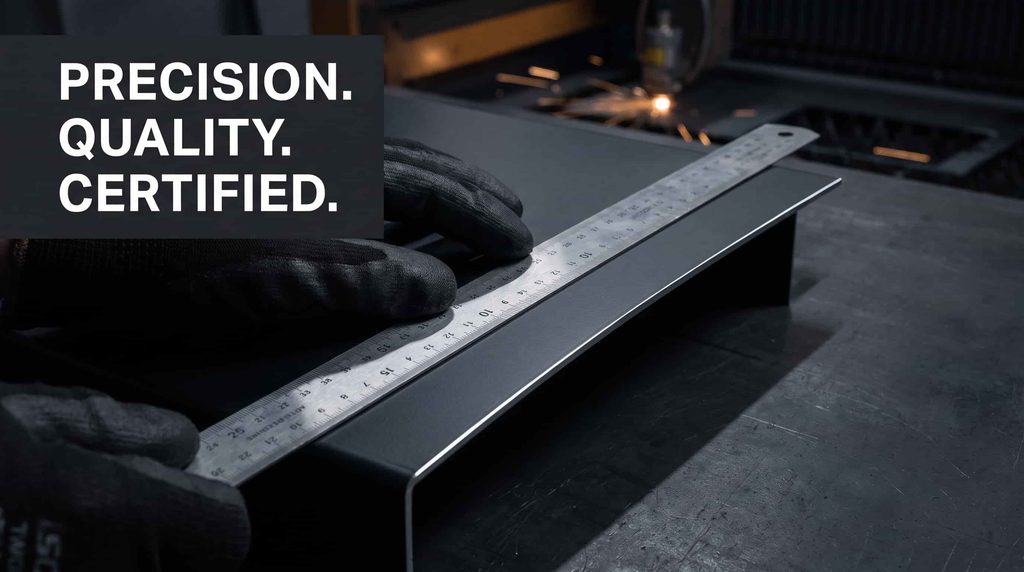
Why Quality Standards Matter in Fabrication Work
When you commission fabricated components — whether for a shopfront, kiosk, or structural element — you’re not just buying a product. You’re buying a process. The difference between a fabrication job that holds up for five years and one that warps, fades, or fails within twelve months almost always comes down to whether proper quality standards were followed at every stage.
In Dubai’s commercial and retail environment, where heat, humidity, and high foot traffic are constant pressures, those standards matter even more.
The Core Quality Benchmarks You Should Know
1. Material Grading and Sourcing
Not all steel, aluminium, or stainless is equal. Quality fabricators work with specified grades — and they document it.
- Mild steel: typically Grade 250 or Grade 350 depending on structural load
- Stainless steel: Grade 304 for most commercial applications; Grade 316 for outdoor or humid exposure
- Aluminium: 6061-T6 for structural parts; 5052 for sheet-form applications
If a supplier cannot tell you the material grade, that is a warning sign.
2. Dimensional Tolerances
Every fabricated part has a tolerance — the acceptable margin between the intended measurement and the actual one. Industry standard for general structural fabrication is ±1.5mm to ±3mm. For precision components, that tightens significantly.
Ask for tolerance specifications upfront. If a supplier gives you a vague answer, they’re not working to a standard — they’re guessing.
3. Weld Quality
Welds are where most fabrication failures start. Quality welds should be:
- Continuous, with no gaps or cold stops
- Ground flush where appearance matters (retail environments especially)
- Free of porosity, undercut, or cracks
- Tested via visual inspection, and in critical applications, non-destructive testing (NDT)
Retail fabrication in particular demands clean, smooth welds — visible weld seams on a display unit or kiosk tell customers something was done cheaply.
4. Surface Finishing Standards
Surface finish is not cosmetic — it determines corrosion resistance and longevity. Common finishing standards:
| Finish Type | Standard | Typical Use |
|---|---|---|
| Powder Coating | BS EN ISO 12944 | Interior and exterior structures |
| Galvanising | BS EN ISO 1461 | High-humidity or outdoor applications |
| Brushed/Mirror Polish | Ra 0.8–1.6µm | Retail fabrication displays, signage |
| Anodising | BS 1615 | Aluminium profiles, facades |
For retail fabrication specifically, powder coat uniformity and edge coverage are the two most common failure points. Inspect corners and cut edges closely.
5. Load and Structural Testing
Any fabricated element that carries weight — shelving, wall mounts, canopies, signage structures — should have a calculated load rating. Reputable fabricators provide structural drawings or load calculations, especially for Dubai Municipality permit submissions.
What Retail Fabrication Quality Looks Like in Practice
Retail fabrication has its own set of expectations beyond structural integrity. You’re working in a space where aesthetics and durability have to coexist.
Here’s what separates average from quality in a retail context:
- Edge finishing: All cut edges should be deburred and chamfered. Raw sharp edges are a sign of rushed work.
- Consistency across units: If you’re ordering ten display units, unit ten should look identical to unit one. Variation means poor process control.
- Coating uniformity: No drips, runs, or thin patches in powder coat or paint. Check under lighting at different angles.
- Fixings and hardware: Quality retail fabrication uses stainless or zinc-plated fixings — not bare steel that will rust within a year.
- Assembly fit: Joints, connections, and panels should fit without force. If it needs hammering together on-site, something was measured wrong.
Red Flags to Watch Before You Approve a Job
These are not minor concerns — each one signals a systemic quality problem:
- No written specification or technical drawing provided before fabrication starts
- Supplier cannot name the material grade they’re using
- No surface treatment documentation
- Welds left unground on visible surfaces
- Significant variation between samples and final delivery
- Vague lead times with no production schedule
If you’re seeing more than one of these, renegotiate before signing off — not after.
Frequently Asked Questions
What tolerances should I expect for standard metal fabrication work?
For general structural metal fabrication, ±1.5mm to ±3mm is the accepted range. Precision parts or components that need to fit with others tightly require tighter tolerances, sometimes under ±0.5mm. Always confirm this in writing before production starts.
How do I verify the quality of welds without specialist equipment?
Start with a visual inspection — look for consistent bead width, no cracks, no gaps, and smooth transitions at start and stop points. For anything structural, ask the fabricator for weld procedure documentation or request a third-party inspection if the stakes are high.
What makes retail fabrication different from standard structural work?
Retail fabrication is held to a higher aesthetic standard. Surface finishes need to be flawless, dimensions need to be consistent across multiple units, and all visible fixings should be concealed or matched to the finish. Structural integrity still matters — but so does the look.
Is powder coating sufficient for outdoor metal fabrication in Dubai?
Powder coating works well outdoors in Dubai when applied over properly prepared steel with a primer coat. For maximum protection in direct sun or coastal exposure, look for coatings rated to ISO 12944 Category C3 or higher.
What documentation should a fabricator provide on project completion?
At minimum: as-built drawings, material certificates, surface treatment records, and a sign-off inspection report. For permitted structures, you’ll also need compliance documentation for Dubai Municipality or the relevant authority.
Final Thoughts
Quality in fabrication is not a given — it’s a process that has to be defined, documented, and verified at every stage. Whether you’re commissioning retail fabrication for a shopfront fitout or structural metalwork for a larger commercial project in Dubai, knowing what to ask and what to inspect puts you in control of the outcome.
A supplier who can answer your quality questions clearly — and back them up in writing — is almost always the right one to trust.
