
What Is a Car Wrap and What’s It Made From?
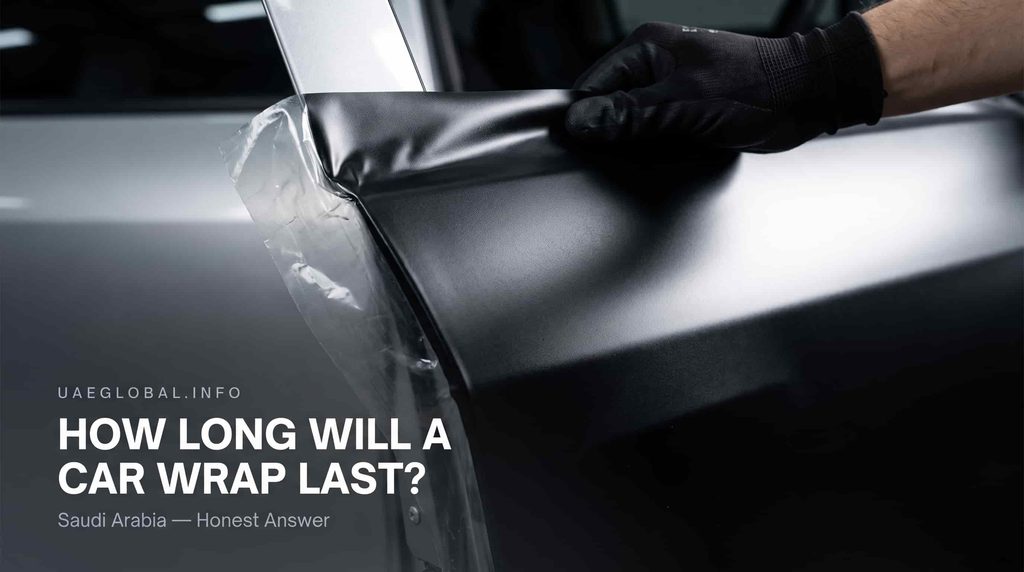
A car wrap is a large-format printed or solid-colour vinyl film applied directly over a vehicle’s painted surface. It covers the paint completely, changes the appearance of the car, and peels off cleanly when removed — leaving the original paint underneath untouched.
The vinyl itself is a thin, flexible PVC film with a pressure-sensitive adhesive on the back. The quality of that film — how it’s manufactured, what additives protect it from UV, and how thick the adhesive layer is — determines how long the wrap holds up in real-world conditions.
How Long Does a Car Wrap Last in Saudi Arabia?
In most countries, a quality car wrap lasts five to seven years. In Saudi Arabia, that number is more honest at four to six years — and here’s why.
The climate in Riyadh and Jeddah is one of the harshest environments vinyl film has to survive in:
- UV index regularly exceeds 10 in summer
- Surface temperatures on parked cars can hit 80°C or above
- Sand and dust create constant micro-abrasion on exposed surfaces
- Humidity along the Jeddah coast accelerates adhesive breakdown faster than dry inland conditions
This doesn’t mean wraps don’t work here. It means the vinyl specification matters more than it does in cooler climates. A wrap installed with the right vinyl, by an experienced installer, will still look sharp after four years in Riyadh. A cheap wrap installed poorly might start lifting at the edges within a year.
Why the Vinyl Brand Makes the Biggest Difference
Not all wrap vinyl is the same. The brand and grade of film used is the single biggest factor in how long your wrap lasts.
Oracal Vinyl — Jeddah
Oracal is one of the most widely used vinyl brands in the Saudi market. Their 970 series is the industry standard for vehicle wraps — cast vinyl, not calendered, which means it conforms to curved surfaces properly without lifting or shrinking over time.
For vehicle wraps in Jeddah specifically, Oracal 970RA is recommended. The RA stands for Rapid Air — a channel system in the adhesive that makes installation easier and reduces bubbling. In Jeddah’s humidity, proper adhesive contact is critical. Trapped air expands in heat and creates lift points that fail early.
Oracal vinyl in Jeddah is widely available through authorised distributors. Always ask your installer which series they’re using — not just the brand name.
Orajet Vinyl — Riyadh
Orajet is Oracal’s printable vinyl range — used specifically for printed wraps where graphics, colours, or branding are involved rather than solid colour films.
For printed car wraps in Riyadh, Orajet 3951 and 3164 are the go-to series. Both are cast films with UV-resistant laminates that hold print colour in high UV environments. Without a UV laminate over a printed wrap, colours fade significantly faster — especially reds and yellows, which are the most UV-sensitive pigments.
Orajet vinyl in Riyadh is used by professional wrap shops for fleet branding, commercial vehicles, and custom printed designs. If your wrap involves any printed graphics, confirm with your installer that they’re using Orajet or an equivalent cast printable film with laminate — not a cheaper calendered alternative.
Cast vs Calendered Vinyl — Why This Matters
This is the technical distinction most buyers never hear about — but it directly affects lifespan.
Cast vinyl is made by pouring liquid PVC onto a casting sheet and letting it cure slowly. The result is a dimensionally stable film that holds its shape, conforms to curves, and doesn’t shrink back after application. Oracal 970 and Orajet 3951 are cast films.
Calendered vinyl is made by pressing PVC through rollers under heat. It’s thicker, cheaper, and has memory — meaning it wants to return to its flat shape after being stretched around curves. On complex body panels, calendered vinyl lifts at edges and curves within months, especially in heat.
For a full vehicle wrap in Saudi Arabia — always cast vinyl. Calendered is acceptable for flat surface applications only.
How Installation Affects Lifespan
The best vinyl in the world will fail early if it’s installed badly. Here’s what good installation looks like:
- The car surface is decontaminated, clay barred, and IPA-wiped before any film goes on
- Panel edges are wrapped, not just covered — the vinyl folds around door edges and under trim
- Heat guns are used to stretch the vinyl around curves properly
- The car is kept out of direct sunlight for at least 24 hours after installation to allow the adhesive to cure
An installer who skips surface prep or doesn’t wrap edges properly is giving you a wrap that will lift within months — regardless of the vinyl brand.
How to Make Your Wrap Last Longer
Once the wrap is on, how you treat the car determines whether you get four years or seven:
- Hand wash only — pressure washers and automatic car washes damage wrap edges and lift seams
- Park in shade where possible — UV is the primary cause of colour fade and adhesive breakdown
- Use wrap-safe detailer spray — regular car wax contains solvents that degrade vinyl over time
- Fix lifting edges immediately — a small lift repaired early costs almost nothing; left alone it becomes a full panel replacement
- Avoid petrol spills on wrapped surfaces — fuel degrades the adhesive layer fast
When Should You Replace a Car Wrap?
Replace it when you see:
- Colour fade that washing doesn’t fix
- Lifting edges that keep coming back after repair
- Cracking or chalking on the surface
- Print colours shifting or looking inconsistent
At that point the film has reached the end of its usable life. Trying to extend it further just risks paint damage when the adhesive becomes harder to remove cleanly.
