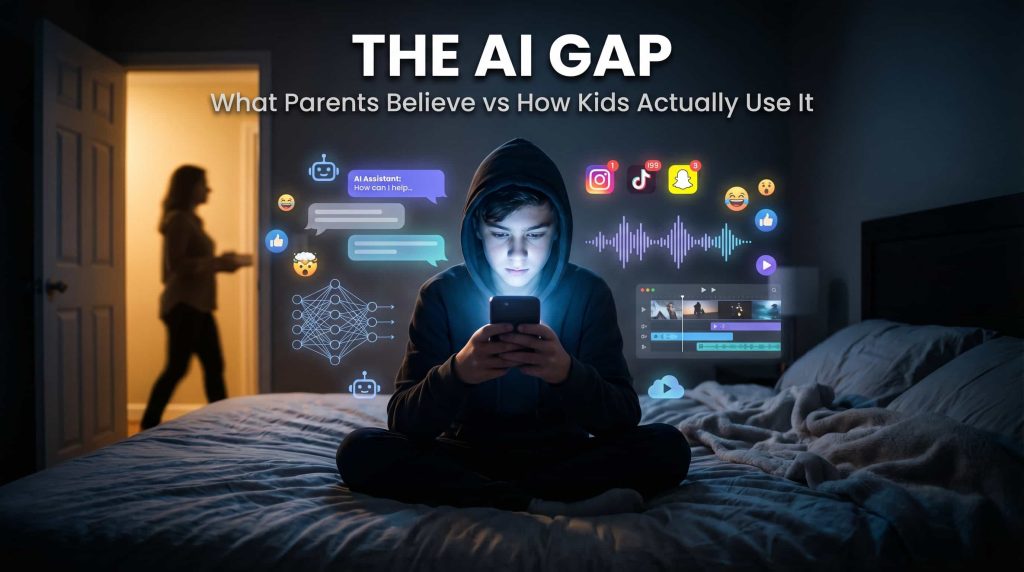

Most parents think they have a solid grip on their children’s digital lives. They set screen time limits, check app downloads, and occasionally peek at a browser history. But the reality? The way kids interact with technology in 2026 — from AI tools to social media to their relationship with their smartphones — looks nothing like what most parents imagine.
The gap between parental assumptions and what’s actually happening is wider than ever. And it’s not just about AI. It’s about the entire digital ecosystem kids are growing up in.
How Kids Actually Use Technology — The Full Picture
Parents tend to see technology through a simple lens: phones are for texting and social media, computers are for homework, and AI is that ChatGPT thing they saw on the news. But for kids, technology is deeply woven into almost every part of their daily lives.
What a Typical Day Really Looks Like
Here’s what a teenager’s day with technology might actually involve:
- Waking up and checking notifications across three different messaging apps
- Using an AI tool to summarise study notes before school
- Editing a short-form video on CapCut during lunch break
- Collaborating on a group project through Google Docs and Discord
- Watching coding or design tutorials on YouTube after school
- Managing a small online resale shop on Depop or Vinted
- Scrolling TikTok for a mix of entertainment and educational content
- Talking to an AI companion app before bed
That’s not a rare day. For millions of young people, that’s just a normal Tuesday.
The AI Side: What Kids Are Actually Doing With It
When parents hear “kids are using AI,” most immediately think of one thing — cheating on homework. And while that does happen, it’s a tiny slice of a much bigger picture.
AI Tools Kids Use Every Day
Young people interact with AI across dozens of platforms, often without even realising it:
- Snapchat My AI — a built-in chatbot millions of teens talk to daily for recommendations, advice, and casual conversation
- AI photo and video editors — tools like Remini, Lensa, and CapCut’s AI-powered features for creating polished content
- AI homework assistants — apps like Photomath, Socratic, and Quillbot that help break down complex problems
- AI music generators — platforms like Suno and Udio where kids create original tracks without any instruments
- AI companion apps — tools like Character.AI and Replika used for conversation, roleplay, and emotional support
- AI writing and brainstorming tools — ChatGPT, Gemini, and Claude for generating ideas, planning projects, and learning new topics
For kids, AI isn’t some futuristic concept. It’s just another layer of the apps they already use.
The Pros of Kids Using AI
It’s not all doom and gloom. When used well, AI genuinely helps young people:
- Personalised learning — AI adapts to a student’s level and explains things in ways they actually understand
- Creative exploration — kids experiment with music, art, writing, and video without needing expensive tools or formal training
- Problem-solving skills — using AI to brainstorm and iterate teaches critical thinking in a new way
- Accessibility — students with learning difficulties benefit hugely from AI tools that simplify, translate, or restructure information
- Early tech literacy — kids who learn to use AI effectively now will have a serious advantage in tomorrow’s job market
The Cons Parents Should Know About
But there are real risks that deserve honest attention:
- Over-reliance — some kids stop trying to solve problems on their own because AI gives instant answers
- Misinformation — AI tools can confidently produce wrong or misleading information, and most kids don’t fact-check
- Emotional dependency — AI companion apps can become a substitute for real human connection, especially for lonely or anxious teens
- Privacy concerns — many AI apps collect personal data, and kids rarely read terms of service
- Academic integrity — the line between “AI-assisted learning” and “AI did my homework” is blurry and getting blurrier
Mobile Addiction: The Silent Struggle Parents Underestimate
Here’s a conversation most families aren’t having honestly — mobile phone addiction. Parents know their kids use phones a lot. But few understand just how deep the dependency goes.
How Mobile Addiction Shows Up in Kids
It’s not always obvious. Mobile addiction doesn’t look like a dramatic crisis. It often looks like:
- Constantly checking the phone even when there are no notifications
- Anxiety or irritability when the phone is taken away or out of reach
- Difficulty concentrating on tasks that don’t involve a screen
- Staying up late scrolling, leading to chronic sleep deprivation
- Preferring online interaction over face-to-face conversations
- Using the phone as the first and only response to boredom, stress, or discomfort
Why It’s Harder to Address Than Parents Think
The challenge is that smartphones aren’t purely harmful. The same device that causes distraction is also the one kids use for learning, socialising, and creative work. You can’t just take it away without cutting off genuinely valuable parts of their lives.
This is where the “screen time” approach falls short. Counting minutes doesn’t distinguish between a kid doom-scrolling for two hours and a kid spending two hours learning video production. The quality of screen use matters far more than the quantity.
The Pros and Cons of Smartphone Use for Kids
The positives:
- Instant access to educational resources and tutorials
- Staying connected with friends and family across distances
- Creative outlets through photography, video, music, and writing
- Learning real-world skills like budgeting, selling, and project management
- Emergency communication and safety features
The negatives:
- Sleep disruption from late-night phone use
- Reduced attention spans and difficulty with deep focus
- Exposure to cyberbullying, inappropriate content, and online predators
- Social comparison and its impact on self-esteem and mental health
- Physical effects like eye strain, poor posture, and reduced physical activity
Social Media: The Biggest Misunderstanding Between Parents and Kids
Ask most parents what social media their kids use, and you’ll hear Instagram, TikTok, and maybe Snapchat. But the social media world young people live in is far more complex than that.
The Hidden Layers of Teen Social Media
Most teenagers maintain multiple digital identities across platforms:
- Main account — the polished, public-facing profile that parents and teachers might see
- Finsta (fake Instagram) — a private account shared only with close friends for unfiltered posts
- Spam account — a casual space for random thoughts, memes, and venting
- Discord servers — community-based spaces organised around gaming, music, art, or niche interests
- Private group chats — on WhatsApp, Telegram, or iMessage, where the real social life happens
Parents who monitor the main account and assume they have the full picture are usually seeing about 20% of their child’s online social life.
Social Media as a Learning Tool
It’s not all selfies and dance trends. Many young people actively use social media to learn:
- Creative skills like drawing, music production, photography, and coding
- Financial literacy and money management basics
- Mental health awareness and coping strategies
- Career advice, university tips, and interview preparation
- DIY projects, cooking, and practical life skills
The problem isn’t that kids are learning from social media — it’s that the quality of information varies wildly. A helpful mental health tip and a dangerously misleading one can sit side by side in the same feed, and most young people lack the media literacy to tell them apart.
Pros and Cons of Social Media for Kids
The positives:
- Building communities around shared interests and passions
- Developing creativity and self-expression
- Access to diverse perspectives and global awareness
- Finding support networks for issues they may not discuss at home
- Learning digital communication and personal branding skills
The negatives:
- Social comparison leading to anxiety, depression, and low self-esteem
- Cyberbullying and online harassment
- Exposure to misinformation and harmful content
- Addictive design patterns that exploit dopamine loops
- Privacy risks from oversharing personal information
The Real Risk Isn’t the Technology — It’s the Disconnect
Here’s what actually keeps child development experts concerned. The biggest danger isn’t AI, social media, or smartphones individually. It’s the growing gap between parents and children when it comes to understanding digital life.
What Happens When Parents Don’t Understand
When parents are out of touch with what their kids are really doing online, a predictable pattern emerges:
- Conversations stay surface-level — “get off your phone” replaces “show me what you’re building”
- Rules are set based on fear and headlines rather than understanding
- Kids sense the disconnect and stop sharing their digital lives altogether
- Trust breaks down, and the gap widens with every new app, tool, or trend
The result? Kids navigate increasingly complex digital environments completely alone — without guidance from the people who care about them most.
What Parents Can Actually Do to Bridge the Gap
The good news is that closing this gap doesn’t require a tech degree or a complete ban on devices. It starts with a mindset shift — from policing to participating.
Practical Steps Every Parent Can Take
- Ask for a guided tour — have your child walk you through their favourite apps, AI tools, and online spaces
- Try the tools yourself — download ChatGPT, explore Snapchat’s My AI, watch what your child watches
- Focus on quality, not time — shift from counting screen minutes to understanding what’s happening during that time
- Talk without punishment — create a safe space where kids can share what they encounter online without fear of losing their device
- Build digital literacy together — learn alongside your child how to spot misinformation, protect privacy, and use AI responsibly
- Set boundaries with context — instead of “no phone after 9pm,” explain why sleep matters and agree on limits together
- Stay curious, not controlling — the goal isn’t to monitor everything, it’s to stay connected enough that your child wants to share
Technology will keep evolving faster than any parenting book can keep up with. But the relationship between parent and child? That’s the one constant that actually makes a difference.
Kids who feel safe talking to their parents about their digital lives are far better equipped to handle the risks than kids who’ve simply been shut out of the conversation.
The gap is real. But it doesn’t have to stay that way.
What AI tools are kids commonly using in 2026?
Kids use AI across many apps without even labelling it as AI. Common tools include Snapchat’s My AI chatbot, AI photo editors like Remini and Lensa, homework helpers like Photomath and Socratic, music generators like Suno, companion apps like Character.AI, and general-purpose tools like ChatGPT and Gemini. AI is built into the apps they already use daily.
Is mobile phone addiction a real problem for kids?
Yes. While it may not always look dramatic, mobile addiction shows up as constant phone checking, anxiety when separated from the device, difficulty concentrating without a screen, chronic sleep loss, and preferring online interaction over real-life conversation. The challenge is that smartphones are also genuinely useful, making it harder to draw clear boundaries.
What are the main pros and cons of kids using technology?
The main benefits include personalised learning, creative exploration, global connectivity, and early digital literacy. The main risks include reduced attention spans, social comparison and mental health impacts, exposure to misinformation, privacy concerns, and over-reliance on technology for problem-solving and emotional support.
What's the biggest mistake parents make about kids and technology?
Focusing on screen time numbers instead of screen quality. An hour spent learning video editing or building a creative project is entirely different from an hour of mindless scrolling. Understanding what kids are doing with technology — and why — matters far more than tracking how many minutes they spend on it.