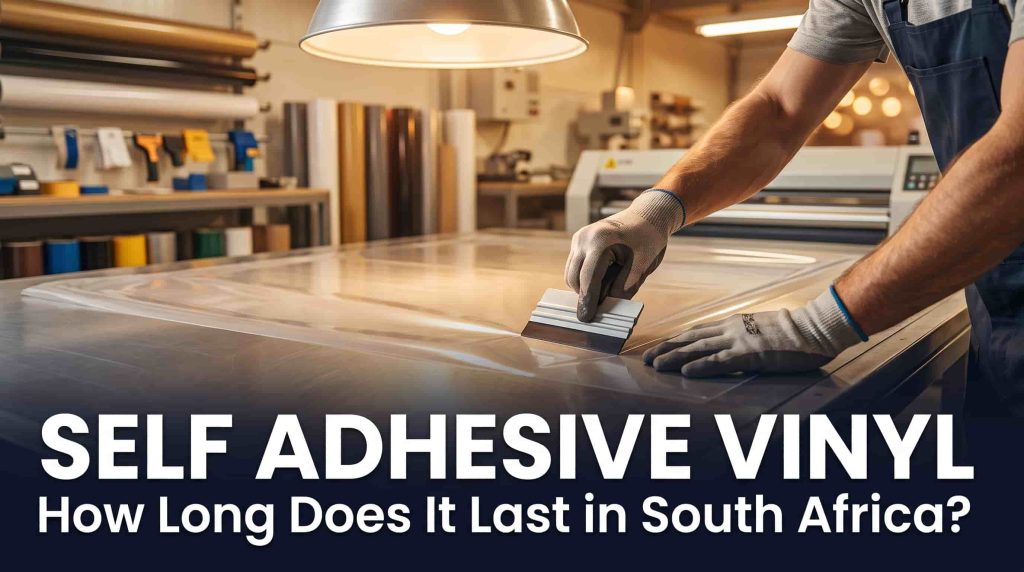

Between 2 and 7 years — that is the honest range. However, where an application lands within that range depends on four factors — and understanding them is straightforward. The grade of vinyl, the surface, the UV exposure, and whether surface preparation was done correctly.
Moreover, most service life failures in South Africa are not product failures. In other words, they are specification failures. The wrong grade for the environment, applied to an inadequately prepared surface, in conditions the material was not rated for. Therefore, understanding what determines service life helps businesses and individuals specify correctly from the outset — rather than discovering the problem when the vinyl starts lifting six months into a three-year campaign.
What Are the Main Grades of Self Adhesive Vinyl?
Not all self adhesive vinyl is the same material. Specifically, the grade — cast or calendered — is the primary determinant of outdoor service life.
Cast vinyl uses a manufacturing process that casts liquid PVC compound onto a release liner and cures it. The resulting film is dimensionally stable and conforms to curved surfaces. It holds colour under UV exposure significantly longer than calendered alternatives. Quality cast vinyl from reputable vinyl suppliers in South Africa carries a 5 to 7 year outdoor durability rating. Furthermore, apply it correctly with a UV-rated protective laminate to achieve this.
Calendered vinyl goes through a series of heated rollers — a faster, more cost-effective process that produces a stiffer, thicker film. Consequently, calendered vinyl has a shorter outdoor service life — typically 2 to 3 years in South Africa’s UV conditions — and suits complex curved surfaces less well. It suits short-term indoor applications and temporary outdoor campaigns. A 12 to 24 month service life is sufficient for these uses.
How Does UV Exposure Affect Self Adhesive Vinyl in South Africa?
South Africa’s UV radiation intensity is among the highest globally. Consequently, this is the most significant environmental factor affecting self adhesive vinyl service life in outdoor applications.
UV radiation breaks down the polymers in the vinyl film and degrades the pigments in the printed ink layers. Without a UV-rated overlaminate, colour fades and the film surface degrades significantly faster than the rated service life. Furthermore, the adhesive layer itself can be affected — UV exposure through unprotected vinyl gradually reduces adhesive tack. Consequently, edge lifting appears before the graphic surface has visibly degraded.
Consequently, every outdoor self adhesive vinyl application in South Africa needs a UV-rated overlaminate — regardless of whether the vinyl itself carries a UV stability rating. The overlaminate protects the print layer and the vinyl surface from UV degradation throughout the intended service life.
How Does Surface Preparation Affect Service Life?
Nevertheless, surface preparation is the most commonly overlooked factor in self adhesive vinyl service life. A perfectly specified vinyl applied to an improperly prepared surface fails from the adhesive layer outward — regardless of the vinyl grade or overlaminate specification.
Specifically, the adhesive bond is only as strong as the surface it contacts. Dust, oil, silicone residue, wax, moisture, and incompatible surface coatings all block full adhesive contact. Furthermore, reduced initial tack worsens as the vinyl expands and contracts through South Africa’s temperature cycles — producing edge lifting, bubbling, and ultimately full delamination.
The correct preparation sequence is: clean with isopropyl alcohol, allow full evaporation, then apply between 15°C and 35°C. Additionally, squeegee down fully to eliminate air pockets.
Self Adhesive Vinyl Service Life by Application
Different applications place different demands on the material. Moreover, the expected service life varies significantly by use case even within the same grade of vinyl.
Vehicle Wraps
Cast vinyl with UV overlaminate on correctly prepared vehicle paintwork lasts 5 to 7 years. Vehicle wraps face sustained UV exposure, road abrasion, and car wash chemical contact. They also handle the thermal cycling of a metal surface parked in direct sun. Consequently, the full specification — cast vinyl, UV overlaminate, and professional application — is not optional here. A wrap applied without overlaminate may look acceptable for 12 to 18 months. After that, degradation is rapid.
Outdoor Signage and Bannerwall Graphics
Vinyl on aluminium composite panels (ACP) for building signage and bannerwall lasts 5 to 7 years. The correct specification is UV-stable cast vinyl with overlaminate. ACP substrates provide a dimensionally stable surface that does not flex. This reduces the mechanical stress on the adhesive bond — and consequently the edge lifting common on flexible substrates. Additionally, ACP-mounted vinyl graphics benefit from the panel’s thermal mass. Consequently, this reduces thermal cycling compared to thinner substrate applications.
Window Graphics and Retail Displays
Indoor window graphics using calendered vinyl last 2 to 3 years before the material stiffens and corners begin lifting. Outdoor window graphics facing direct sun need cast vinyl and UV overlaminate. Furthermore, glass surface preparation must be thorough. Specifically, glass picks up invisible residue from cleaning products — and any residue under the vinyl creates visible bubbling within weeks.
Promotional and Short-Term Displays
Calendered vinyl on rigid substrates including PVC foam sheet and corrugated plastic lasts 12 to 18 months in indoor applications. PVC foam sheet provides a lightweight, rigid surface that holds vinyl well in exhibition and retail display environments. For outdoor short-term campaigns of 6 to 12 months, unlaminated calendered vinyl performs adequately. Moreover, the service life matches the campaign duration.
Floor Graphics
Floor applications require an anti-slip overlaminate rated for foot traffic. Standard print overlaminates do not carry a floor use rating. However, a floor graphic with anti-slip overlaminate lasts 3 to 6 months in normal foot traffic conditions — longer in low-traffic areas, shorter in high-footfall retail or exhibition environments.
What Cuts Self Adhesive Vinyl Service Life Short?
Nevertheless, most premature failures share the same root causes. These apply across all vinyl applications in South Africa regardless of the substrate or environment.
Under-specification for the environment — using calendered vinyl where cast is required — or applying unlaminated vinyl outdoors — is the most common premature failure cause in the South African advertising materials suppliers market. However, early replacement costs recover the specification saving multiple times over.
Incorrect application temperature — applying vinyl below 15°C reduces the initial adhesive tack. In South Africa’s highveld winter, morning application temperatures can fall below this threshold. Cold-applied vinyl achieves only partial adhesion. Therefore, edge lifting appears once the material goes through several thermal cycles.
Incompatible surface coatings — some paint formulations, silicone sealants, and panel coatings do not bond with standard pressure-sensitive adhesives. Additionally, this applies to aluminium composite panels and polycarbonate sheets particularly. Therefore, specifying an adhesion promoter or primer for incompatible surfaces resolves the issue before application — not after the vinyl has been installed and failed.
No UV overlaminate on outdoor applications — already covered above, but worth stating directly. Every outdoor vinyl application in South Africa’s UV conditions requires a UV-rated overlaminate. Moreover, no exceptions.
Frequently Asked Questions
How long does self adhesive vinyl last in South Africa?
Self adhesive vinyl lasts between 2 and 7 years in South Africa depending on the grade, the application, and the UV and weather exposure it faces. Cast vinyl with UV overlaminate in outdoor applications lasts 5 to 7 years. Calendered vinyl in indoor or short-term applications lasts 2 to 3 years.
What is the difference between cast and calendered self adhesive vinyl?
Cast vinyl is manufactured for long-term outdoor durability — 5 to 7 years in South Africa’s outdoor conditions with correct overlaminate. Calendered vinyl is manufactured for cost-effective shorter-term applications — 2 to 3 years outdoors, longer indoors. Cast vinyl conforms better to curved surfaces and holds colour under UV exposure significantly longer.
Does self adhesive vinyl need a UV overlaminate in South Africa?
Yes — for all outdoor applications. South Africa’s UV radiation intensity accelerates colour fading and surface degradation in unprotected vinyl significantly faster than rated service life. A UV-rated overlaminate protects both the print layer and the vinyl surface throughout the intended outdoor service life.
Why does self adhesive vinyl peel or lift early in South Africa?
The most common causes are inadequate surface preparation, application below 15°C, incompatible surface coatings, and use of calendered vinyl in applications requiring cast. Each of these prevents full adhesive contact at installation — the failure becomes visible as the vinyl goes through thermal cycles.