
A signage board identifies a business, communicates a brand, and directs people to a location. Every commercial building in Dubai carries some form of signage — a name on a facade, a logo above a retail entrance, a directory board at an office tower base. Consequently, it is the first thing a customer sees before interacting with the business itself.
In Dubai’s commercial environment — high density, constant visual competition — a board does three jobs simultaneously. Furthermore, it does them all at once. Specifically, it identifies. It communicates brand quality. And it performs over time in one of the most demanding outdoor climates in the world. Moreover, a board that delivers all three correctly is a permanent, passive marketing asset. One that fails on any single function becomes a liability.
What Are the Main Types of Signage Board in Dubai?
The signage industry in Dubai supplies a wide range of board types for different commercial applications. Each type suits a specific position, environment, and brand objective.
Fascia Boards
A fascia board mounts directly to the front face of a building or shopfront. Furthermore, it is the most common type across Dubai’s retail, hospitality, and corporate environments. Fascia boards use aluminium composite panel (ACP) as the primary substrate — PVDF-coated for outdoor durability — with dimensional lettering, vinyl graphics, or integrated LED illumination applied to the face.
Dimensional Letter Boards
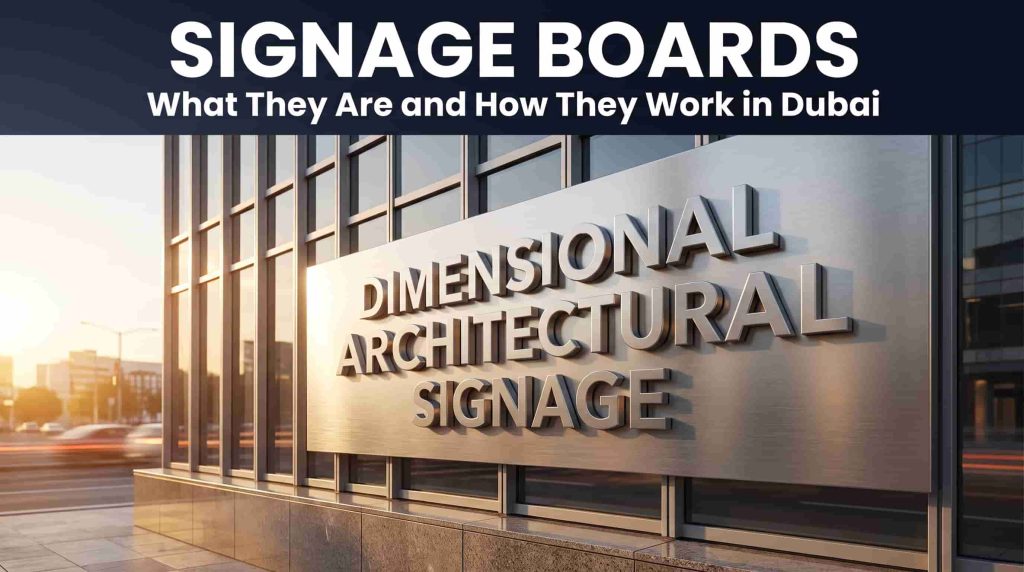
Dimensional letter boards use individually fabricated letters or logos mounted directly to the building facade. Each letter stands proud of the wall surface. Consequently, it creates a three-dimensional effect that flat printed boards cannot replicate. Stainless steel, acrylic, and aluminium are the most commonly used materials. Furthermore, brushed or mirror-finish stainless steel lettering is the standard specification for premium environments across Dubai.
Illuminated Signage Boards
Illuminated boards integrate LED lighting into the board structure — either front-lit, back-lit, or halo-lit depending on the design. They maintain visibility in Dubai’s evening and night-time commercial environment. Therefore, illuminated signage is the standard specification for retail and hospitality environments that trade beyond daylight hours — which, in Dubai, covers most commercial activity.
Pylon and Totem Boards
Pylon and totem signage boards are freestanding structures positioned away from a building facade — typically at the road boundary of a commercial property. They appear across Dubai’s petrol stations, shopping centres, and hotels where the building sits back from the road. Additionally, pylon boards carry branding that is visible from a distance and at driving speed — a completely different viewing context from facade-mounted signage.
Wayfinding and Directory Boards
Wayfinding boards direct people through complex commercial environments — multi-tenant office buildings, retail developments, hotel campuses, and mixed-use developments. In Dubai’s large-scale commercial environment, wayfinding signage is a discipline in its own right. A poorly designed wayfinding system creates friction for every visitor — throughout the entire operational life of the building.
Outdoor Signage Boards
Outdoor signage covers any board positioned in a fully exposed outdoor environment — roadside hoardings, building wraps, external pylon structures, and site signage boards. Outdoor signage in Dubai faces UV radiation, temperatures above 45°C, sandstorm abrasion, and coastal humidity near the Creek and Marina. Consequently, material specification for outdoor signage in Dubai is significantly more demanding than for indoor or semi-outdoor positions.
What Is Signage Fabrication?
Signage fabrication is the process of designing, manufacturing, and installing a signage board — from raw materials through to the finished installation on the building or structure.
A full-service signage company in Dubai handles every stage of this process in-house. Specifically, the design team works from the brand brief and site survey. Fabricators cut, bend, weld, and finish the structural components. Graphic teams produce and apply the print elements. Installation teams fix the finished board to the building within the project’s access window.
Moreover, the distinction between a signage supplier and a signage fabricator matters in Dubai’s commercial market. However, a supplier sells a product. A fabricator produces it — and is accountable for its performance from design through to installation. Additionally, signage industries that fabricate in-house carry the full project responsibility. Otherwise, those that subcontract fabrication create accountability gaps between design intent and delivered result.
Why Does Signage Board Quality Matter in Dubai?
Dubai’s commercial environment is one of the most visually competitive in the world. Every building on Sheikh Zayed Road, every retail unit, every hotel entrance in JBR carries a board. Moreover, the quality signal each one sends is immediate — and it is received before any conversation, product experience, or service interaction takes place.
Nevertheless, a correctly fabricated board in Dubai communicates that the business behind it is worth engaging with. A poorly fabricated board — one that fades within 18 months, whose lettering alignment is inconsistent, or whose surface finish degrades in Dubai’s outdoor conditions — communicates the opposite.
Additionally, the signage industry in Dubai operates within specific regulatory requirements for commercial signage installation. Consequently, building permit requirements, material specifications for certain zones, and installation standards all apply. Therefore, a professional signage company in Dubai navigates these requirements as part of the project — not as an afterthought after fabrication is complete.
What Should a Signage Board Include?
However, the content and design of a signage board depend on its function. However, most commercial signage boards in Dubai include the following elements:
Brand identity — the business name and logo at a size that is clearly readable from the typical viewing distance of the board’s position. A board that requires a pedestrian to stand directly in front of it to read the business name has failed its primary function.
Brand colours and finish — accurately reproduced brand colours on the correct surface finish for the environment. Furthermore, colour accuracy on signage fabrication requires calibrated processes — approximate colour matches degrade the brand signal the board is intended to send.
Contact or direction information — for wayfinding and directory boards, the relevant floor, unit, or direction information presented in a format that is readable at the relevant viewing distance without requiring the viewer to stop and study it.
Frequently Asked Questions
What is a signage board?
A signage board identifies a business, communicates a brand, and directs people to a location. It is the primary visual brand asset for any commercial property in Dubai — the first point of contact between the brand and everyone who sees the building.
What are the main types of signage board in Dubai?
The main types are fascia boards, dimensional letter boards, illuminated boards, pylon and totem boards, wayfinding and directory boards, and outdoor signage boards. Each suits a different position, environment, and brand objective across Dubai’s commercial landscape.
What is the difference between a signage board and a sign?
In common use the terms are interchangeable. In the signage industries, a signage board typically refers to a fabricated display structure — as opposed to a simple printed sign. A signage board has a structural substrate, surface finish, and mounting system. A sign may refer to a simpler printed or cut element without these components.
How long does a signage board last in Dubai?
A correctly specified and fabricated signage board in Dubai lasts 8 to 12 years before the surface finish needs refreshing. Under-specified materials — polyester-coated ACP instead of PVDF-coated, calendered vinyl instead of cast vinyl — show visible degradation within 18 to 36 months in Dubai’s outdoor conditions.
How do I choose a signage company in Dubai?
Choose a signage company in Dubai that conducts a site survey before quoting, specifies materials for Dubai’s climate rather than applying a standard catalogue specification, fabricates in-house, and provides a clear warranty on both materials and installation workmanship.