
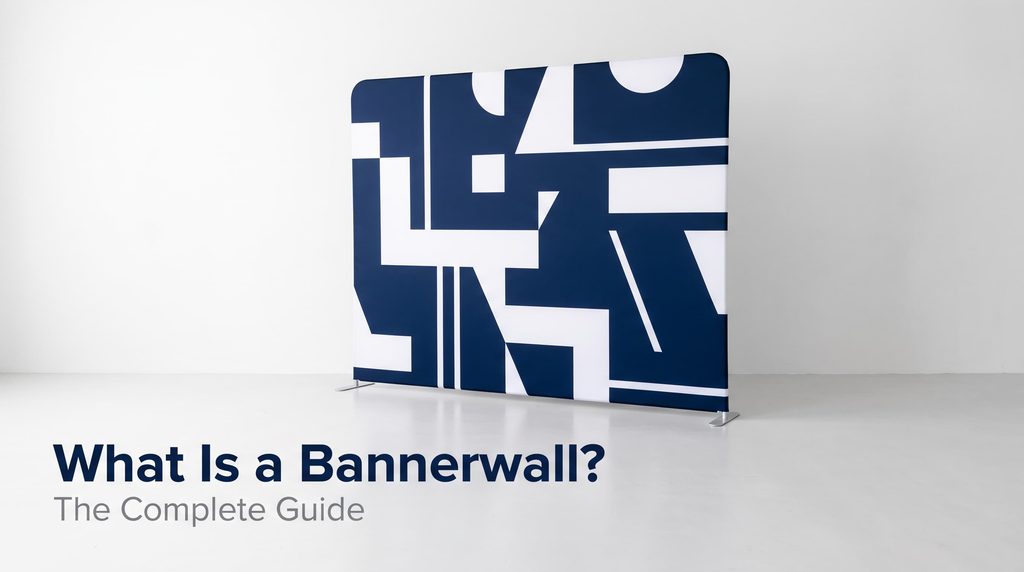
What Exactly Is a Bannerwall?
A Bannerwall is a large-format fabric display system designed to cover a full wall or backdrop area at events, exhibitions, conferences, and retail activations.
It combines two things: a lightweight aluminium frame that assembles quickly without tools, and a printed fabric panel that stretches over it like a pillowcase. The fabric pulls tight across the frame, eliminating wrinkles and creating a completely flat, seamless surface.
The result is a wall-sized display that looks like it was professionally installed — but takes one person about fifteen minutes to set up.
How Does a Bannerwall Work?
The system has three core components:
The frame
Aluminium extrusion bars that click or slot together to form a rectangular skeleton. The frame is lightweight, which makes it easy to transport and assemble. Most frames come in carry bags that fit in a car boot or check in as luggage.
The fabric panel
A single piece of printed fabric — usually dye-sublimation printed for sharp, vibrant colour reproduction. The fabric has a silicone edge bead sewn around its perimeter. That bead slides into a groove on the frame, pulling the fabric taut as it goes in.
The feet or wall-mounting hardware
Depending on the application, Bannerwalls either stand freestanding with feet attached to the base of the frame, or mount directly onto a wall with brackets. Freestanding versions are more common at events because they need no wall attachment at all.
Once the fabric is locked into the frame, there are no visible fixings, no gaps, and no creases. It looks like a printed wall, not a display stand.
Where Are Bannerwalls Used?
They show up in more places than most people realise:
- Trade shows and exhibitions — behind booth counters as full backdrop displays
- Corporate conferences — on stage behind speakers and panels
- Product launches — as the visual backdrop for press photography and video
- Retail stores — as in-store feature walls for promotions or seasonal campaigns
- Sports events — as branding backdrops at press conferences and podiums
- Hospitality — hotel lobbies, event spaces, and conference rooms
- Photography studios — as branded or plain-colour backdrops
Anywhere you need a large, clean branded surface quickly — a Bannerwall fits.
Bannerwall vs Regular Roller Banner — What’s the Difference?
This is the question that comes up most often.
A roller banner is a single retractable unit, roughly 85cm wide. It’s compact, affordable, and works well as a standalone display next to a reception desk or at a small exhibition stand.
A Bannerwall is a completely different scale. It covers an entire wall or backdrop — typically starting at 2 metres wide and going up to 6 metres or more. It’s not a standalone unit. It’s a full visual environment.
Here’s a simple comparison:
| Roller Banner | Bannerwall | |
|---|---|---|
| Width | 85cm – 150cm | 2m – 6m+ |
| Setup time | 1 minute | 10 – 20 minutes |
| Fabric or rigid? | Rigid printed panel | Stretch fabric |
| Seamless look? | No | Yes |
| Best for | Small stands, reception areas | Stages, full backdrops, exhibitions |
| Reusable frame? | Yes | Yes |
Can You Reuse a Bannerwall?
Yes — and this is one of the biggest financial arguments for them.
The aluminium frame is reusable indefinitely. When your campaign changes or you need different graphics for a new event, you only replace the fabric panel. The frame stays. That means your second and third events cost significantly less than the first.
For businesses that exhibit regularly — at trade shows, expos, or industry conferences — this reusability makes Bannerwalls far more cost-effective over time than buying new rigid displays every year.
What Size Bannerwall Do You Need?
Size depends entirely on your space and what you’re trying to achieve.
A rough guide:
- 2m x 2m — small booth backdrop, compact event space
- 3m x 2.5m — standard exhibition stand backdrop
- 4m x 2.5m — medium stage backdrop or larger booth
- 6m x 3m — full stage backdrop, large-scale events
Always measure the wall or space first, then work backwards to the frame size. A Bannerwall that’s too wide for your space looks awkward. One that’s slightly narrower than the wall looks intentional and clean.
What Makes a Good Quality Bannerwall?
Not all Bannerwalls are the same. Here’s what to check before you buy or order:
Frame quality
The aluminium profile should be thick enough to hold tension without bowing. Thin, cheap profiles warp under tight fabric — especially on wider frames. Ask about the profile thickness before ordering.
Fabric weight and print quality
Dye-sublimation printing on 200gsm to 280gsm polyester fabric is the standard for sharp, vibrant output. Cheaper inkjet-printed fabric fades faster and shows banding in large solid colour areas.
The silicone bead
The bead that slots the fabric into the frame needs to be sewn cleanly and consistently. A poorly sewn bead causes the fabric to pull unevenly, creating visible tension lines across the display.
Carry case
A good Bannerwall comes with a proper carry bag or wheeled case. If the supplier doesn’t include one, factor in the cost of transport and storage separately.
Is a Bannerwall Worth the Investment?
For a business that exhibits more than twice a year — yes, without question.
The upfront cost is higher than a set of roller banners. But the per-event cost drops sharply once you’re reusing the frame. The visual impact is also in a different category entirely. A well-printed Bannerwall makes a small booth look professional and deliberate. A collection of roller banners makes it look like the display was assembled last minute.
For once-off events where budget is tight — a Bannerwall might be overkill. In that case, a quality roller banner or pull-up display does the job.
But if you’re building a brand presence at events and you want people to remember your space — a Bannerwall is the right tool.
