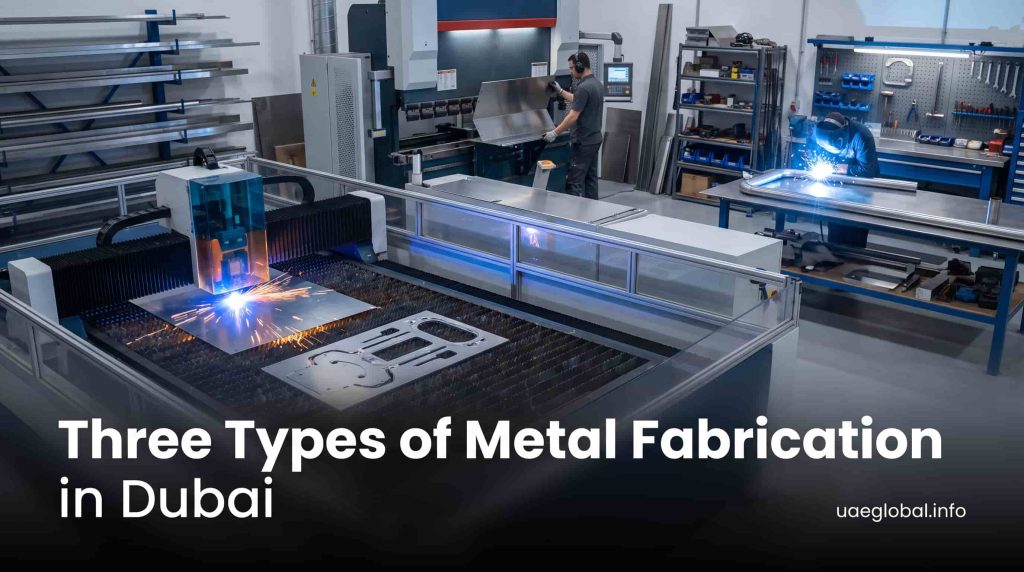

Look at any commercial space in Dubai — a corporate reception area, a retail shopfront, a branded kiosk in a mall — and you are looking at the result of three processes. Cutting. Forming. Joining. Every metal component in that space passed through all three before it arrived on site.
Metal fabrication in Dubai covers a wide range of commercial applications. However, the process is always the same sequence — cut the material to size, form it into shape, join the pieces together. Understanding what each stage involves helps businesses brief fabricators more accurately and evaluate suppliers more confidently.
Type 1 — Cutting
Every fabrication project starts here. Before a component can take shape, the fabricator must reduce the raw material — sheet metal, plate, extrusion, or tube stock — to the dimensions the design requires. Three cutting methods handle the majority of work in Dubai’s commercial sector.
CNC plasma cutting drives a controlled plasma arc through metal sheet at speed. It handles thicker sections efficiently — from 3mm up to 25mm and beyond. Fabricators use it for structural components, brackets, and frames where speed matters more than edge finish. It is fast and cost-effective for high-volume structural work.
Laser cutting produces far cleaner edges than plasma. The focused laser beam cuts through sheet metal with a precision that needs no secondary finishing. Consequently, fabricators specify laser cutting for signage components, retail display panels, and decorative metalwork where the cut edge forms part of the finished visual. Furthermore, letter forms for 3D signage and precision-fit kiosk components all benefit from the accuracy laser cutting delivers.
Waterjet cutting handles materials that cannot tolerate heat. Certain stainless steel grades develop heat-affected zones under plasma or laser — waterjet avoids this entirely. Additionally, composite substrates and non-metallic materials that appear in mixed-material retail fit-out projects require waterjet rather than thermal cutting methods.
Type 2 — Forming
Cutting delivers flat components. Forming gives them three-dimensional shape. The fabricator applies controlled force to bend, roll, or press the material into the profile the design requires.
Press brake bending is the most widely used forming process in Dubai. A press brake applies force along a straight line to bend sheet metal at a precise angle. Fabricators use it to produce counter returns, display unit sides, channel letter faces, and the structural brackets that connect built elements to building substrates.
Press brake quality shows immediately in the finished installation. Consistent bend angles and accurate dimensions across multiple identical components mark quality forming work. Moreover, when bending is inconsistent — angles that vary, dimensions that drift — the problems compound at assembly. Gaps, misalignments, and rework follow — all avoidable with quality press brake work at the forming stage.
Roll forming bends sheet metal progressively through a series of rollers to produce curved profiles. Curved counter fronts, cylindrical column cladding, and radius details in shopfitting and retail fabrication applications typically require roll forming rather than press brake work. The continuous curve rolling produces is smoother and more consistent than a series of press brake bends approximating a curve.
Type 3 — Joining
Cutting and forming produce the individual components. Joining assembles them into the finished structure. Welding is the primary joining process in metal fabrication in Dubai’s commercial sector.
MIG welding is the production standard. It is fast, versatile, and capable across a wide range of metal types and thicknesses. Fabricators use MIG welding to join structural frames, brackets, and assemblies in retail fabrication, construction fit-outs, and commercial interiors. Furthermore, MIG is the practical choice for structural joins that surface finishes or internal assemblies will subsequently cover.
TIG welding produces higher quality welds with finer control over the heat input and finished bead. A quality TIG weld, ground flush and polished to match the surrounding surface, disappears entirely — leaving no visible evidence of the join. Consequently, TIG welding is the standard for stainless steel reception counters, visible display fixture joins, and any commercial application where the weld faces direct inspection in the finished installation.
The distinction matters in Dubai’s premium retail and hospitality environments. A MIG weld on a visible stainless steel surface communicates something about fabrication quality — even when it is technically sound. A TIG weld in the same position communicates nothing. That invisibility is the point.
Mechanical fastening — bolts, rivets, and structural fixings — handles joins where welding is not accessible, where components need disassembly, or where the design requires adjustable connections. In retail fabrication and exhibition stand construction, mechanical fastening connects fabricated components to building substrates and allows modular assemblies to reconfigure across multiple events or fit-out phases.
How All Three Types Work Together in Dubai
A practical example clarifies the sequence. Consider a powder-coated aluminium shopfront frame for a Dubai retail unit. This is the kind of metal fabrication in Dubai that determines how a retail environment reads from the street.
First, laser cutting produces the individual aluminium sections with the dimensional accuracy and edge quality the visible installation requires. Next, press brake bending forms those sections into the face frame, the returns, and the connection flanges the design specifies. Then MIG welding joins the structural elements. TIG welding closes the visible corners. Finally, powder coating applies the brand’s RAL colour across the completed frame. The result arrives on site ready for installation — every join, every dimension, and every surface resolved in the workshop.
This sequence — cut, form, join, finish — drives metal fabrication in Dubai across signage fabrication, retail fabrication, exhibition stand construction, and architectural metalwork throughout the UAE.
Frequently Asked Questions
What are the three types of metal fabrication in Dubai?
The three main types are cutting — which produces components from raw sheet material using CNC plasma, laser, or waterjet processes; forming — which shapes flat components into three-dimensional structures using press brakes and roll forming; and joining — which assembles components into finished structures through MIG welding, TIG welding, and mechanical fastening.
What is the difference between MIG and TIG welding in Dubai’s commercial sector?
MIG welding is faster and more cost-effective. Fabricators use it for structural joins and components where the weld will not be visible in the finished installation. TIG welding produces a finer, higher-quality weld — specified for stainless steel and any visible join in premium commercial and retail fabrication in Dubai. Most projects use both — MIG for structure, TIG for visible surfaces.
What is laser cutting used for in retail fabrication in Dubai?
Laser cutting suits components where edge quality forms part of the finished visual — signage letter forms, display fixture panels, precision-fit shopfitting components, and decorative metalwork. The clean edge laser cutting produces needs no secondary finishing. Consequently, it is the standard process for visible metalwork in Dubai’s retail fabrication market.
How does metal fabrication apply to retail projects in Dubai?
Retail fabrication in Dubai uses all three types in sequence. Laser cutting produces components with the edge quality retail applications require. Press brake bending forms counters, display units, and structural frames. TIG welding joins visible surfaces to a finish that is invisible in the completed installation. The three processes work together to produce every fabricated element in the retail environment.