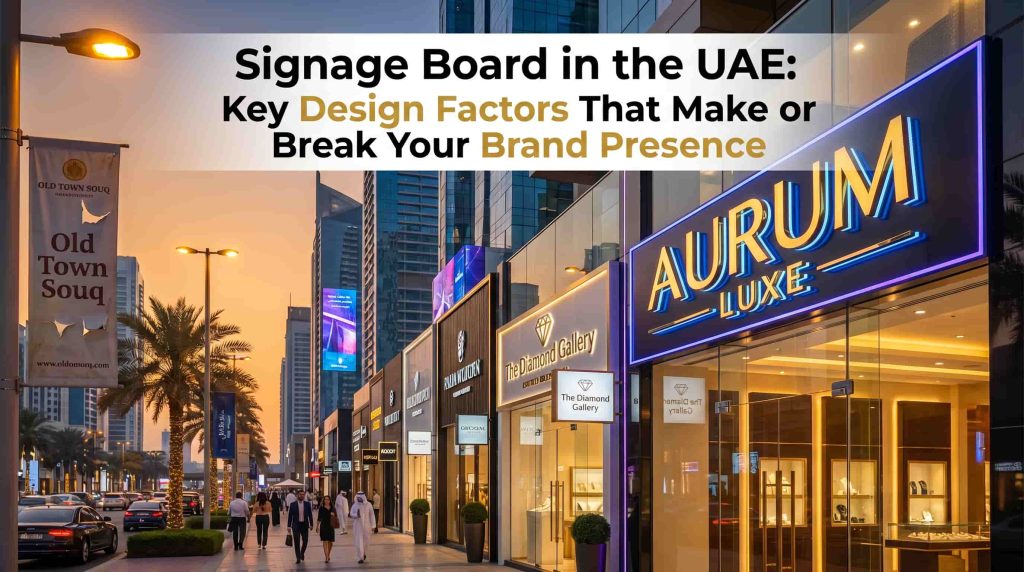

Your signage board is working every single day — or it is working against you every single day. There is no middle ground.
In the UAE, where retail competition is fierce, commercial districts are saturated with visual noise, and first impressions are formed in seconds, a poorly designed signage board does not just fail to attract attention. It actively signals to potential customers that your brand does not take itself seriously.
A well-designed signage board, on the other hand, does something remarkable: it earns attention, communicates your brand, and drives footfall without saying a word. It works at 3am when your store is closed. It works from across a busy Dubai street. It works for every single person who walks or drives past your location.
This guide covers the key design factors that determine whether your signage board builds your brand or undermines it — specifically in the context of the UAE market.
Why Signage Board Design Is Different in the UAE
The UAE is not a generic market. Signage board design here operates under specific conditions that do not apply in most other countries — and ignoring those conditions produces results that look fine on a design screen but fail in the real world.
Key UAE-specific factors that affect signage board performance:
- Extreme UV exposure — Dubai and Abu Dhabi receive some of the highest UV radiation levels globally. Colours fade, materials degrade, and finishes crack faster here than in temperate climates. Material and finish selection must account for this from day one
- High ambient brightness — the UAE sun creates intense ambient light conditions for most of the year. A signage board that looks bold and punchy in a design mockup can wash out completely in direct midday sunlight
- Multilingual audience — the UAE population is one of the most diverse in the world. Signage board design must consider readability across Arabic and English at minimum, with layout and hierarchy decisions that serve both script directions
- Regulatory environment — Dubai Municipality, Abu Dhabi City Municipality, and free zone authorities all have specific regulations governing signage board dimensions, placement, illumination, and content. Non-compliant signage gets removed
- Visual competition density — commercial areas like Sheikh Zayed Road, Deira, Business Bay, and Mall of the Emirates corridors are extraordinarily visually dense. Standing out requires deliberate design decisions, not generic templates
These factors make the UAE one of the most demanding environments for signage board design in the world — and one of the most rewarding when the design is executed correctly.
Factor 1: Visibility and Legibility at Distance
The primary job of any signage board is to be seen and read. Everything else — colour, material, lighting, aesthetics — serves that primary function.
Visibility and legibility in UAE conditions depend on:
Letter Height and Font Selection
The viewing distance from which your signage board needs to be legible determines the minimum letter height. A general rule applied by experienced signage companies in Dubai: for every 3 metres of viewing distance, letter height should be a minimum of 25mm for a clearly legible message.
A signage board on a Sheikh Zayed Road building needs to be legible from 100+ metres. That requires significantly larger lettering than a shopfront sign designed for pedestrian viewing at 5 metres.
Font selection matters equally. Highly decorative fonts, condensed typefaces, and thin stroke weights all collapse at distance or in bright light conditions. Clean, geometric sans-serif fonts with strong stroke contrast perform best in UAE outdoor signage conditions.
Contrast Ratio
Low contrast between text and background is the most common legibility failure in signage board design. Light text on a light background, or dark text on a dark background, becomes illegible in bright UAE sunlight even at close range.
High contrast combinations — white on dark navy, black on yellow, white on deep red — maintain legibility across all lighting conditions and distances. Always test your contrast ratio in simulated daylight conditions before finalising a signage board design.
Factor 2: Material Selection for UAE Conditions
The UAE climate is one of the harshest environments for exterior signage materials in the world. Temperatures regularly exceed 45°C in summer. UV intensity is extreme. Sandstorms deposit abrasive particles on surfaces. Coastal locations add salt air corrosion to the list.
Material selection for signage boards in the UAE must be driven by durability in these conditions — not just by appearance in a showroom.
Aluminium Composite Panel (ACP)
ACP is the dominant substrate for flat signage boards across the UAE market. It is lightweight, rigid, weather-resistant, and available with PVDF coating that significantly extends colour retention under UV exposure. For flat fascia signage, ACP is the standard specification for good reason.
Stainless Steel and Powder-Coated Aluminium
For dimensional lettering, logo cutouts, and premium signage applications, stainless steel and powder-coated aluminium deliver durability and finish quality that painted or vinyl-applied alternatives cannot match over time in UAE conditions.
Acrylic Faces with LED Illumination
Illuminated signage boards using acrylic faces with LED modules behind them are the standard for retail and commercial signage across Dubai. The combination delivers consistent brightness, energy efficiency, and a clean finish that performs well in both daytime and nighttime conditions.
What to Avoid
- Vinyl-faced foam board — degrades rapidly in UAE heat and UV exposure. Acceptable for short-term indoor applications only
- Untreated mild steel — corrodes quickly in UAE humidity, particularly in coastal areas
- Standard polyester-coated ACP — significantly shorter colour retention life than PVDF-coated alternatives under UAE UV conditions
Factor 3: Illumination Strategy
In the UAE, a signage board that is not illuminated is invisible for a significant portion of its working hours. Dubai’s retail and commercial environments operate well into the night. Illumination is not optional for most business signage applications — it is a core design requirement.
Illumination options for signage boards in the UAE:
Front-Lit Signage
External floodlights or spotlights directed at the signage board face. Cost-effective for large flat signage on building facades. The limitation is light spillage and the difficulty of maintaining even illumination across a large surface.
Back-Lit (Lightbox) Signage
The signage board face — typically printed or applied onto a translucent acrylic or polycarbonate panel — is illuminated from behind by an LED array. This produces even, consistent illumination across the full sign face with no hotspots. The most widely used illumination method for retail signage boards across Dubai.
Halo-Lit (Reverse-Lit) Dimensional Letters
Individual dimensional letters are mounted proud of the backing panel with LED modules inside. Light spills behind and around each letter, creating a halo glow effect on the backing surface. This technique produces a premium, high-end aesthetic used extensively in luxury retail, hotel, and corporate signage applications across the UAE.
Channel Letters with Face Illumination
Individual fabricated letter forms with acrylic faces, illuminated internally with LEDs. Each letter glows independently. A highly visible, distinctive signage format widely used across UAE retail and hospitality environments.
For any illuminated signage board in Dubai, LED specification should account for UAE ambient temperature conditions — LEDs operating in confined signage cabinets in 45°C+ summer heat require appropriate thermal management to maintain lifespan and consistent light output.
Factor 4: Brand Consistency
A signage board is a brand touchpoint — often the first physical brand touchpoint a potential customer experiences. Inconsistency between your signage board and your other brand materials creates a subtle but real erosion of brand trust.
Brand consistency on signage boards means:
- Exact colour matching — pantone references must be accurately translated to the specific output method being used, whether digital print, vinyl application, powder coating, or LED face illumination. Each method renders colour differently and requires calibration
- Typography accuracy — the fonts used on your signage board must match your brand guidelines exactly. Substituting similar-looking fonts is not acceptable in professional signage execution
- Logo proportions and clear space — logo lockups on signage boards must respect the proportions and minimum clear space requirements in your brand guidelines. Distorted or cramped logos on signage boards are more damaging to brand perception than most businesses realise
- Finish consistency — if your brand communicates premium quality, a gloss laminate finish on your signage board reinforces that. A flat, low-quality substrate undermines it regardless of how accurate the print is
Working with an experienced signage company in Dubai that understands brand reproduction across different output methods is critical to achieving consistent results.
Factor 5: Regulatory Compliance in the UAE
This is the factor most businesses overlook until it costs them time and money.
Signage boards in Dubai require approval from the relevant authority before installation. The approval process varies depending on location:
- Dubai Municipality governs signage on most commercial and residential properties within Dubai
- Free zone authorities (DIFC, JAFZA, DAFZA, Dubai Internet City, etc.) each have their own signage regulations and approval processes for tenants within their jurisdictions
- Mall management for any signage inside or on the facade of a shopping mall — approval from the mall’s brand and design team is required in addition to any municipal requirements
- Roads and Transport Authority (RTA) approval is required for any signage that is visible from or adjacent to major roads
Common regulatory requirements across UAE signage approvals:
- Maximum signage board dimensions relative to the building or unit facade
- Illumination restrictions in certain zones or time windows
- Mandatory inclusion of Arabic text in specified proportion to English text
- Restrictions on certain colours, imagery, or content categories
- Structural engineering sign-off for large or elevated signage installations
A professional signage company in Dubai handles the regulatory approval process as part of the project scope — ensuring your signage board is compliant before fabrication begins, not after installation when removal orders create costly delays.
Factor 6: Installation Quality and Structural Integrity
A signage board is only as good as its installation. Poor installation is a safety issue, a maintenance issue, and an aesthetic issue — often all three simultaneously.
In the UAE, signage board installations must account for:
- Wind load — Dubai experiences significant wind events, particularly at height. Large signage boards on building facades must be engineered to withstand wind pressure without failure
- Thermal expansion — materials expand and contract significantly across the UAE’s temperature range. Fixings and mounting systems must accommodate this movement without creating stress fractures or loosening over time
- Substrate compatibility — the mounting surface (concrete, glass, ACP cladding, render) determines the fixing method. Incorrect fixings fail prematurely in UAE conditions
- Waterproofing at penetration points — any fixing that penetrates a building envelope must be properly sealed to prevent water ingress during the UAE’s intense but infrequent rainfall events
Ambert Industries handles signage board installation across Dubai and the UAE with engineering-grade fixing systems and full compliance with UAE structural and safety requirements.
Factor 7: Maintenance Planning
A signage board is a long-term asset. Like any asset, it requires maintenance to retain its performance and appearance over time.
In the UAE, signage board maintenance requirements include:
- Regular cleaning — Dubai’s dust and sandstorm environment deposits significant particulate matter on signage surfaces. Dirty signage boards lose brightness and legibility. Regular cleaning with appropriate methods maintains appearance
- LED module inspection and replacement — LED arrays in illuminated signage boards have finite lifespans. Individual module failures create dark patches that significantly damage brand appearance. Planned LED maintenance prevents unplanned failures
- Sealant and fixing inspection — annually inspect all sealant joints, fixing points, and structural connections on exterior signage boards. UAE temperature cycling and UV exposure degrade sealants over time
- Face panel condition — printed or vinyl-applied faces on signage boards require periodic replacement as UV exposure causes colour shift and surface degradation over time
Factor maintenance requirements and costs into your total signage board investment from the start. A premium signage board with a planned maintenance programme delivers significantly better value over its lifespan than a cheaper installation that degrades rapidly.
Working with a Signage Company in Dubai
The quality of your signage board outcome depends heavily on the signage company you work with. In Dubai’s competitive signage market, capability and quality levels vary significantly across suppliers.
When evaluating a signage company in Dubai for your project, assess:
- Portfolio of completed UAE projects — relevant experience in your industry and signage type
- In-house fabrication capability — companies that fabricate in-house have more control over quality and lead times than those who subcontract production
- Regulatory knowledge — do they handle the approval process or leave it to you?
- Material specifications — are they specifying UAE-appropriate materials or cutting costs with inferior alternatives?
- Installation team — do they have trained, experienced installation crews or do they subcontract to the cheapest available labour?
Ambert Industries is a Dubai-based signage company with full in-house design, fabrication, and installation capability across the UAE. The team handles everything from initial concept and regulatory approval through to fabrication, installation, and ongoing maintenance — delivering signage board solutions that perform in the UAE’s demanding environment.
What materials are best for outdoor signage boards in the UAE?
PVDF-coated aluminium composite panel is the standard substrate for flat outdoor signage boards in the UAE. For illuminated applications, acrylic faces with LED modules are the most widely used combination. Stainless steel and powder-coated aluminium are preferred for dimensional lettering and premium applications.
Do signage boards in Dubai require regulatory approval?
Yes. Signage boards in Dubai require approval from Dubai Municipality, the relevant free zone authority, or mall management depending on the location. A professional signage company in Dubai will handle the approval process as part of the project scope.
How long do signage boards last in UAE conditions?
With quality materials and proper maintenance, a well-specified signage board in the UAE should last between seven and fifteen years. PVDF-coated substrates, UV-stable inks, and quality LED components all extend service life significantly compared to lower-specification alternatives.
What is the best illumination method for a retail signage board in Dubai?
Back-lit lightbox signage and halo-lit dimensional letters are the most widely used illumination methods for retail signage boards in Dubai. The best choice depends on your brand aesthetic, budget, and the specific installation environment.


