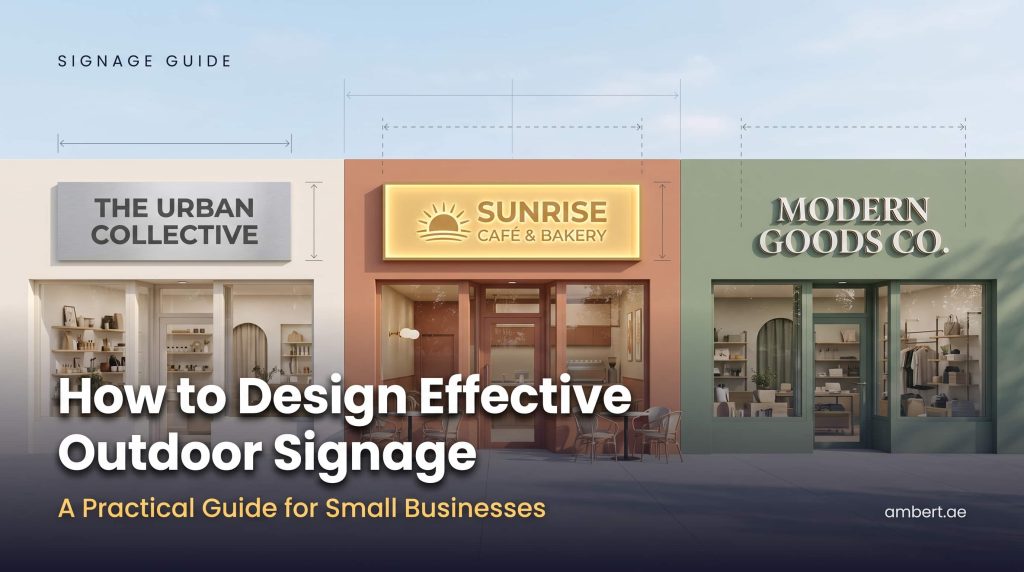

For a small business, first impressions happen outside — long before a customer walks through the door. A well-designed sign can stop someone mid-stride, communicate what you offer in seconds, and make your business memorable enough to return to. A poorly designed one, no matter how strong your product or service is, quietly costs you customers every single day.
The good news is that effective signage doesn’t require a massive budget. It requires the right decisions — about design, materials, placement, and messaging. Here’s what every small business owner needs to know.
Why Outdoor Signage Still Matters for Small Businesses
In a world dominated by digital marketing, it’s easy to underestimate the power of a physical sign. But a person driving or walking past your location sees your sign repeatedly — day after day. That repetition builds familiarity, and familiarity builds trust.
The Passive Visibility Advantage
Unlike a social media post that disappears in a feed, a well-placed sign works for you 24 hours a day, 7 days a week — with no ongoing cost once it’s installed. Studies consistently show that a significant percentage of customers discover local businesses simply by noticing their frontage signage. For small businesses operating without large advertising budgets, that kind of round-the-clock visibility is incredibly valuable.
Signage as a Brand Statement
Beyond attracting foot traffic, your sign communicates your brand personality before anyone steps inside. A clean, well-crafted sign signals professionalism and attention to detail. A faded, cluttered, or poorly mounted one does the opposite — regardless of how good your actual product or service is.
Key Design Principles Every Small Business Should Follow
Good outdoor signage design is not about making something that looks impressive to you — it’s about communicating instantly to a stranger passing by at speed. These principles will keep every decision on the right track.
Simplicity Always Wins
The most common mistake small businesses make is trying to say too much. A sign is not a brochure. Lead with your business name or one clear message. If someone needs more than three seconds to understand what you do, you’ve already lost them.
Legibility Over Creativity
Decorative fonts, low-contrast colour combinations, and overcrowded layouts might look interesting up close, but they fail at a distance. Use clean, bold typefaces with strong contrast between text and background. Your sign should be readable from across the street — or further.
Using Colour Intentionally
Colour does two things — it attracts attention and communicates brand personality. High-contrast combinations like dark backgrounds with light text, or bold colours against neutral surroundings, perform best outdoors. Avoid using more than two or three colours on a single sign to maintain visual clarity.
Getting the Size Right
A sign that’s too small for its location is practically invisible. Before committing to dimensions, consider the distance from which most people will view it — whether from a footpath, a road, or across a car park — and size accordingly. When in doubt, go larger.
One Clear Call to Action
If your sign has room for a contact detail or a short action prompt, use it wisely. If space is tight, don’t force it. Cluttered signs with phone numbers, websites, social handles, and slogans all competing for attention end up communicating nothing at all.
Choosing the Right Materials for Your Outdoor Sign
Material choice directly affects how your sign looks, how long it lasts, and how much maintenance it requires. Choosing the wrong material can mean paying twice — once for the sign, and again when it needs replacing sooner than expected.
Aluminium Composite Panel (ACP)
One of the most practical and cost-effective options for flat outdoor signs. Lightweight, weather-resistant, and easy to produce with high-quality print results. A solid choice for fascia signs, name boards, and flat display panels across most commercial settings.
Acrylic Panels
Acrylic offers a premium look and is available in a wide range of colours and finishes. UV-stable grades hold their colour well under direct sunlight, making them reliable for long-term outdoor use. Commonly used for 3D lettering, illuminated signs, and display faces on lightboxes.
Vinyl Graphics on Rigid Substrates
Printed vinyl applied to aluminium or Dibond is a flexible, affordable solution that produces sharp, vibrant results. For outdoor durability, always specify UV-laminated, outdoor-grade vinyl with a minimum 5-year weather rating. Ideal for temporary promotions, window displays, and secondary signage.
Illuminated LED Signs
LED-lit signs — whether lightboxes or individual channel letters — dramatically increase visibility after dark. For businesses with evening trading hours or located in competitive commercial areas, the investment in illumination typically pays off quickly through increased footfall and brand visibility.
Common Outdoor Signage Mistakes Small Businesses Make
Even with the best intentions, small businesses frequently make the same avoidable errors. Knowing what not to do is just as valuable as knowing what to do.
Overcomplicating the Design
Too many fonts, too many colours, too much information — all of these reduce the effectiveness of a sign. Every element you add competes for attention. Strip it back to the essentials and your message becomes stronger, not weaker.
Ignoring the Viewing Environment
A sign that looks great in a design file may be unreadable in its actual location due to background clutter, competing colours, or poor lighting conditions. Always assess the real-world context — time of day, surrounding environment, viewing angle — before finalising any design.
Skipping Professional Installation
A beautifully designed sign mounted crookedly, at the wrong height, or with visible fixings immediately undermines the impression it was meant to create. Professional installation is not an optional extra — it’s part of the finished product.
Underestimating Maintenance Needs
Outdoor signs accumulate dust, UV fading, and weather damage over time. Factor in periodic cleaning and occasional maintenance from the outset, rather than waiting until deterioration becomes obvious to customers.
How to Get the Most Value from Your Signage Budget
Small businesses don’t always have room for large signage investments, but there are smart ways to stretch a budget without compromising on impact.
Prioritise Your Primary Sign First
If budget is limited, focus on one well-made, well-placed primary sign rather than spreading spend across multiple lower-quality signs. A single strong sign consistently outperforms several weak ones.
Choose Timeless Over Trendy
Design trends change, but a clean, classic sign with your business name, logo, and brand colours will never look out of place. Avoid designs that might feel dated within two or three years — you’ll end up paying to replace them sooner than planned.
Evaluate Quotes Beyond the Price
Don’t compare quotes on price alone. Compare materials, production methods, installation inclusions, and warranty terms. The cheapest quote often excludes details that add up significantly later in the process.
Think Total Cost of Ownership
A sign that costs more upfront but lasts ten years with minimal maintenance will almost always be more economical than a budget option replaced every two to three years. Factor lifespan into every purchasing decision, not just the initial invoice.
How much does a basic outdoor sign cost for a small business?
Costs vary widely depending on size, material, and complexity. A simple flat aluminium panel sign can start from a few hundred dirhams, while illuminated 3D letter signs typically begin from AED 1,500 upward depending on specifications and installation requirements.
What is the single most important element of effective business signage?
Legibility. A sign that can be read quickly and clearly at a distance will always outperform a visually elaborate sign that takes effort to understand. Simplicity and contrast are the two most powerful tools in any sign design.
How long should a quality outdoor sign last?
well-fabricated sign using quality materials and proper installation should last between 5 and 10 years under normal conditions. In harsh climates, using UV-resistant and weather-rated materials is essential for achieving that lifespan.
Is an illuminated sign worth the extra investment for a small business?
If your business trades during evening hours or sits in a competitive commercial location, illuminated signage is strongly worth considering. The uplift in after-dark visibility can make a measurable difference in daily foot traffic and brand recognition.


