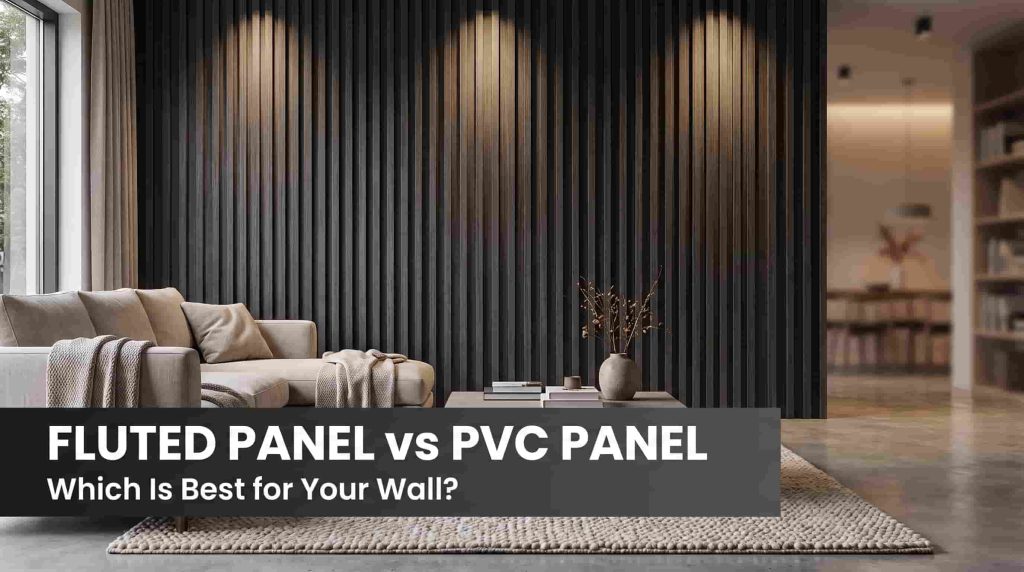

Both are wall panel products — neither requires tiling or plastering to install. Moreover, both come in a wide range of colours and finishes. The question is not which one is better overall — it is which one suits the specific wall, the specific room, and the specific look you are trying to create.
The difference between the two comes down to one thing: surface profile. A fluted panel has a ribbed, three-dimensional surface — vertical grooves running from top to bottom that create shadow lines and visual depth. A flat PVC panel has a smooth or lightly textured surface with no groove profile. However, that one difference changes how each performs in terms of visual impact, light behaviour, and room type suitability.
What Is a Fluted Panel?
A fluted panel is a wall panel with a vertically ribbed surface profile. The grooves run floor to ceiling. Consequently, they create raised ridges and recessed channels across the full panel face. Under directional lighting — wall-mounted spots, LED strip lighting, or natural light from a nearby window — these grooves consequently create dramatic shadow lines that make the wall look three-dimensional.
This is why ribbed wall panels dominate current interior design trends. They add visual interest and depth to a flat wall without any structural work. Furthermore, they create a premium appearance that paint and flat wall cladding panels cannot replicate. Moreover, the shadow effect changes throughout the day as natural light moves — making the wall look different in morning light versus evening artificial light.
These panels are available in timber-effect finishes, solid colours, and stone-effect surfaces. Currently, the most popular finishes are warm timber tones and deep charcoal — both suit the neutral palettes that dominate contemporary interior design.
What Is a Flat PVC Wall Panel?
A flat PVC wall panel covers the wall in a smooth or lightly textured surface — no grooves, no ribbed profile, no shadow effect. The surface can replicate marble, stone, tile, concrete, or solid colour finishes. Furthermore, it is fully waterproof and installs with panel adhesive directly over existing surfaces.
Flat PVC wall panels are the practical choice for wet areas — bathrooms, kitchens, laundry rooms, and splash-backs. The smooth surface has no groove lines to collect moisture, soap residue, or cleaning product. Therefore, one wipe cleans the full surface. Flat panels in marble or stone-effect finishes create a high-end bathroom appearance. Nevertheless, the cost is a fraction of natural stone — and the maintenance is far simpler.
These are the decorative wall panels most commonly used in wet-room applications across residential and commercial interiors.
Key Differences — Fluted Panel vs Flat PVC Panel
Visual Impact
The ribbed panel creates significantly more visual impact than a flat panel on the same wall. The three-dimensional ribbed surface catches light, creates shadow depth, and draws the eye. By contrast, a flat panel creates a clean, seamless surface — visually calmer but less dramatic.
Choose the ribbed option for feature walls where visual impact is the priority. Choose flat PVC panel for surfaces where a clean, seamless background is the goal.
Room Type Suitability
Ribbed wall panels suit dry interior spaces — living rooms, bedrooms, home offices, dining rooms, and retail or hospitality interiors. The groove profile is a visual feature, not a functional requirement. Therefore, the choice is purely aesthetic in dry room applications.
Flat PVC wall panels suit wet rooms — bathrooms, kitchens, laundry areas, and splash-back surfaces. The smooth surface is fully waterproof with no groove lines for moisture or bacteria to accumulate. Consequently, this is the correct wall cladding for functional wet-room applications.
Choose the ribbed panel for living spaces and feature walls. Choose flat PVC panel for bathrooms, kitchens, and any wet-room application.
Installation
Both install with panel adhesive on clean, flat, dry wall surfaces. Neither requires specialist tools or structural work. Furthermore, a standard feature wall in either material installs in a single day for a competent DIY installer or interior contractor.
The main practical difference is cutting. The ribbed profile requires cuts that align with the groove — misaligned cuts at edges and corners are visible. Flat panels cut cleanly at any point without the alignment requirement. Additionally, corners and edges on the ribbed version need purpose-made trim profiles. Flat panels, however, use standard edge trim that is simpler to work with.
Flat PVC panels are simpler to install at corners and edges. Fluted panels require more attention to groove alignment at cut edges.
Cost
Both materials sit in a similar price bracket for standard residential applications. The cost difference between a quality fluted panel and a quality flat PVC panel of equivalent size is modest. Furthermore, installation labour cost is comparable — both are adhesive-fixed panel systems with similar preparation requirements.
The cost variable is finishing. Ribbed panels require corner trim profiles that align with the groove — these add a small material cost. By contrast, flat panels use standard edge trim that is less expensive and more widely available.
Overall cost: broadly comparable — flat panels have a slight edge on finishing material cost.
Maintenance
Flat PVC wall panels are easier to maintain. The smooth surface wipes clean with a damp cloth. Additionally, no groove lines collect dust, moisture, or cleaning product residue.
However, the grooved surface requires slightly more attention during cleaning — the channels collect dust and need cleaning with a soft brush or cloth that reaches into the channels. In dry room applications, however, this is minimal. In kitchen or bathroom environments — which is why flat panels are the correct choice there — the groove cleaning requirement would be significant.
Choose flat PVC panel where easy cleaning is a priority. Choose fluted panel where visual impact outweighs cleaning convenience.
Wall Cladding Ideas — Which Panel for Which Room
These wall cladding ideas show where each panel type performs best. Consider these common residential and commercial applications — each one illustrates where the two panel types perform differently:
Living room feature wall — ribbed wall panel in warm timber tone or deep charcoal. Full-height installation behind the sofa or TV unit. Paired with LED strip lighting at the top edge.
Bedroom feature wall — a ribbed panel behind the bed head. Creates a premium hotel-suite aesthetic. Warm timber or natural linen-effect finish suits most bedroom palettes.
Bathroom walls — flat PVC marble-effect panel on shower walls and bath surrounds. Fully waterproof, no grout lines, easy to clean. The marble finish creates a high-end appearance at a fraction of real stone cost.
Kitchen splash-back — flat PVC panel behind the hob and sink. Installs in hours. No tiling, no grout, easy to wipe clean.
Home office — a ribbed panel on the wall behind the desk. Creates a professional background for video calls. Deep navy or charcoal is the most popular finish for this application.
Restaurant or retail interior — a fluted panel on the primary feature wall. The dimensional surface communicates premium quality and design investment to customers. Wall cladding panels in hospitality environments significantly affect how customers perceive the brand.
Fluted Panel vs PVC Panel — Comparison at a Glance
| Factor | Fluted Panel | Flat PVC Panel |
|---|---|---|
| Visual impact | High — shadow depth and texture | Moderate — clean and seamless |
| Best room | Living rooms, bedrooms, offices | Bathrooms, kitchens, wet rooms |
| Waterproof | Yes — but grooves suit dry rooms | Yes — smooth surface suits wet rooms |
| Installation | Moderate — groove alignment needed | Easy — cuts cleanly at any point |
| Maintenance | Grooves need brush cleaning | Wipe clean with damp cloth |
| Cost | Comparable | Slightly lower finishing cost |
| Trend status | Dominant in current interior design | Classic — consistently practical |
Frequently Asked Questions
What is the difference between a fluted panel and a PVC wall panel?
A fluted panel has a vertically ribbed surface profile that creates three-dimensional shadow depth. A flat PVC panel has a smooth or lightly textured surface. Both are decorative wall panels — the difference is purely the surface profile and the room types each suits best.
Which is better for a bathroom — a fluted panel or a flat PVC panel?
Flat PVC panel is the correct choice for bathrooms. The smooth surface is fully waterproof with no groove lines for moisture or bacteria to accumulate. Fluted panels suit dry interior spaces where the visual impact of the grooved surface is the priority.
Are fluted panels easy to install?
Yes — fluted panels install with panel adhesive on clean, flat wall surfaces without specialist tools. Corners and cut edges require more attention to groove alignment than flat panels. A standard feature wall installs in one day.
What wall cladding ideas work best with fluted panels?
Fluted panels work best as full-height feature walls in living rooms, bedrooms, home offices, and hospitality interiors. Pair with warm directional lighting to maximise the shadow depth effect across the grooved surface. Warm timber tones and deep charcoal are the most popular finishes for current wall cladding ideas.
Where are decorative wall panels used in commercial interiors?
Decorative wall panels — including fluted panels and flat PVC panels — are used across retail environments, restaurant interiors, hotel lobbies, corporate receptions, and office fit-outs. Fluted panels are the most specified decorative wall panel in current commercial interior design across South Africa and the UAE.